How Music Works: Inside the Musical Mind wins Humanities Education Award 2026
Audience Award for Authors in Focus: Contemporary American Writers
26 June 2026
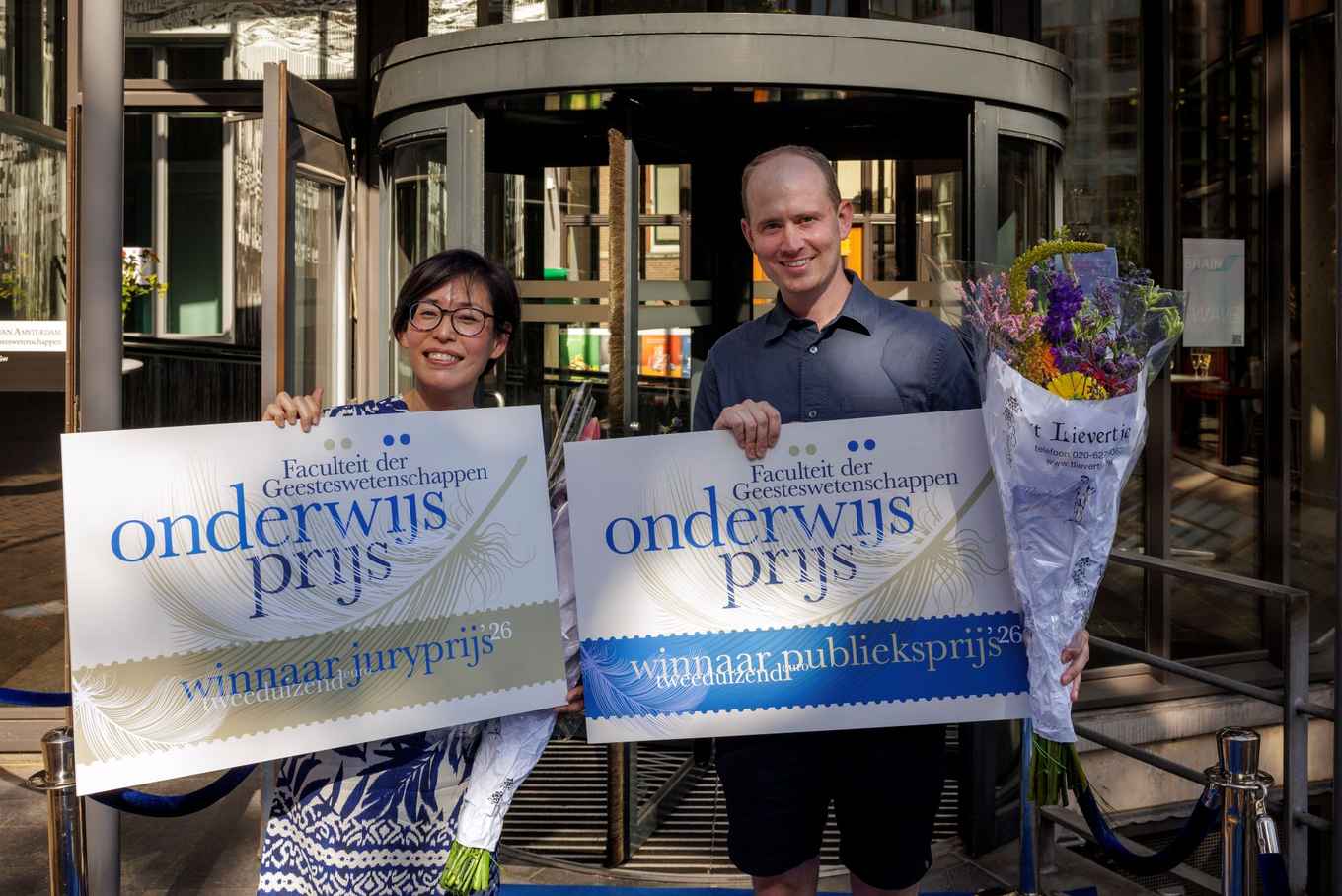
Jury prize for How Music Works: Inside the Musical Mind
In selecting the winner, the jury paid particular attention to the course structure, the quality of its assessment and the way it actively engages students with the subject matter. In all these respects, How Music Works: Inside the Musical Mind by Makiko Sadakata stood out. According to the jury, the course showcases the breadth of the humanities and excels at connecting theory with practice.
What makes the course truly distinctive, however, is not so much its subject matter as its teaching approach. Thanks to its clear structure, the course reimagines what a university course can be. Rather than simply absorbing and reproducing knowledge, students learn from one another, bridging knowledge gaps in ways that a traditional seminar rarely achieves.
The course connects everyday experiences with academic insights, making complex ideas relevant and accessible. Students described it as 'groundbreaking', 'a breath of fresh air' and 'a highlight of my studies'. The jury praised the course for its highly innovative approach to teaching and the excellent results achieved through its creative assignments.
Audience Award for Authors in Focus
The jury applauds Authors in Focus: Contemporary American Writers by Marc Farrant for combining innovative teaching methods with a high degree of societal relevance. The course demonstrates that complex theoretical issues need not remain confined to the books we read, but should instead be engaged with and applied. Its popularity among the voting UvA community was also reflected in its strong course evaluations and the relatively high number of people who initially nominated it. Voters praised the course for addressing crucial and relevant issues in contemporary society, helping students develop their own voice and for the lecturer's dedication to teaching and to creating an environment in which everyone can learn as much as possible.
The course assignments are based on the age-old principle that imitation leads to mastery, bringing this teaching method into the modern age. At a time when the craft of writing is under increasing pressure, the course seamlessly incorporates creative assignments into its teaching. These assignments are not used as graded exercises, but as a means of entering into dialogue with the literature discussed. According to the jury, writing is the most powerful technology humanity has invented.
The nominees
Six courses stood a chance to win the Humanities Education Award 2026. The shortlist was chosen from courses nominated by students and staff. In addition to the winning courses, these were:
Artivism in Action
In Artivism in Action: Exploring Socially Engaged Art, Politics and Culture by Corina Apostol, students explore how artists have worked across art, activism, politics, and community engagement, and how these practices have shaped debates about participation, collaboration, institutional critique, and public responsibility. In the final project, students design an exhibition project. As such, the course unleashes a lot of creativity in the students.
Performing Ecokritiek
Lisa Skwirblies' Performing ecokritiek: Theater, theorie en het actuele discours explores how theatre studies and the theater world relate to the human induced climate crisis and starts from the observation that the theatre world is actually quite advanced in this field. For the final project, students design a special issue for a theatre magazine on ecocriticism. This mobilises their creative skills and helps them ask the right questions.
Publieksfilosofie
The course Publieksfilosofie by Daan Roovers introduces students to the theory and practice of public philosophy by providing them with a thorough introduction to the philosophy of the public sphere and inviting them to hone their philosophical skills in the public sphere. This course satisfies a demand among students to bring their philosophical knowledge and skills to bear in public by learning how to turn philosophy into a much needed public tool.
Visual Art and Power
Anna Lawrence's Visual Art and Power explores how art is used to uphold, enhance, resist and reform existing power structures, making it an entry point for students to explore art's societal relevance. Students are asked to choose artists whose work engages with power (im)balances and to prepare a pitch for the City of Amsterdam to realise an art project on this topic.
Jury
The jury consisted of:
- P.W. Zuidhof – director of education College of Humanities
- Stef Spronck – staff member/chair of the programme committee Dutch Studies
- Kenzo Eulink – student member/chair of the programme committee (R)MA History
- Hanneke Stuit – staff member/chair of the programme committee (R)MA Literary Studies
- Bloem van Tilburg – student member/vice-chair of the programme committee Theatre Studies
Watch the videos on the other nominated courses below: