From Spike Lee to Poor Cinema: Rethinking Success in Black Cinema
7 July 2026
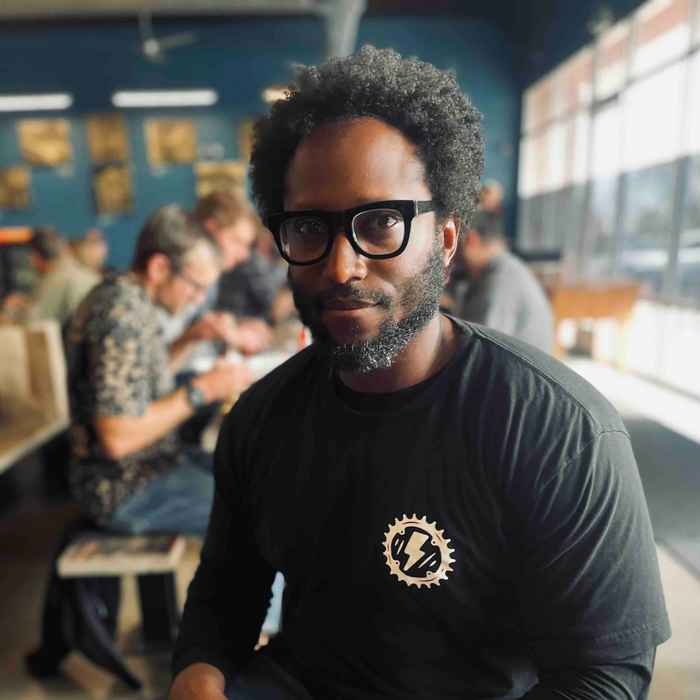
Myers’ research was prompted by his personal experiences in the film industry. Before entering academia, he worked as an actor, musician and filmmaker. ‘I studied at the USC School of Cinematic Arts in Los Angeles and in my first year I was given the assignment to make a short film. What I submitted was experimental and deviated from conventional films, and my lecturer responded that something like that would never work in Hollywood. From that moment on I began to ask myself why Hollywood should be the standard for what good cinema is, and that question has stayed with me to this day.’
In his dissertation, Myers looks for alternatives to Hollywood in a long but often forgotten history of radical Black filmmakers. He refers, among others, to pioneers such as Oscar Micheaux and to the L.A. Rebellion: a group of African American filmmakers who, from the late 1960s onwards, studied at the University of California, Los Angeles (UCLA).
‘The filmmakers of the L.A. Rebellion resisted the stereotypical representations of Black people in Hollywood films. Their work was often experimental, political and closely connected to the lived reality of Black communities. Instead of putting commercial success formulas at the centre, they explored how film could contribute to awareness, emancipation and social change.’
White cinema in blackface
According to Myers, much of that tradition has faded into the background over the years. Since the 1990s, a large part of Black cinema has become increasingly integrated into Hollywood’s commercial logic. ‘Black filmmakers have become more visible since then, but they are still working within the aesthetic and ideological frameworks dictated by Hollywood. I saw that in my own surroundings as well. Black filmmakers were determined to become the next Spike Lee, without asking themselves why they wanted to become that kind of filmmaker in particular.’
Myers sums up this development provocatively as white cinema in blackface: films with Black makers or actors that nevertheless start out from the values, structures and narrative forms of a predominantly white film industry.
‘The past decades have shown us that the presence of successful Black celebrities or filmmakers does not automatically lead to an improvement in the position of Black communities. If the same structures remain intact, representation does nothing to change the underlying power relations.’
Poor cinema
In his dissertation, Myers therefore advocates a form of filmmaking that explicitly focuses on the experiences, history and social reality of Black communities. An important part of this theory is the concept of poor cinema: a way of working that starts from the means that are available, without filmmakers waiting for funding from film funds or major production companies.
‘Artistic choices do not always arise from abundance, but precisely from limitations. If you want to work independently, you have to learn to embrace those limitations in order to tell the story you want to tell. Poor cinema creates opportunities within filmmaking precisely because it is a relatively young art form and there is still ample room to invent something new. My research is of course focused on Black cinema, but any marginalised community is free to adopt these principles, develop them further and apply them to its own context and film culture. The point is to create a form of cinema that is bold, distinctive and innovative, and that calls existing norms and power structures into question.’