How a deleted selfie turns teenage girls into targets for Facebook ads
Interview with Joanna Strycharz on consumer rights in the age of AI
17 July 2026
An increasingly personalised, yet blurry online world
In a world where our digital environment is becoming more and more personalised, consumer rights are under pressure. Advertising messages are increasingly subtle, personalised communications that tap into behaviour, preferences and even emotions. Companies collect enormous amounts of data and use artificial intelligence (AI) to make their communication as effective as possible.
According to Strycharz, this is a problem because consumers have little insight into what is happening. People often don’t know:
- which data about them is being collected,
- how that data is processed,
- how their online profiles are created,
- and how companies use those profiles to target and influence them.
“The system has become so complex that consumers not only don't have enough information, but can barely understand it anymore. As a result, important rights come under pressure: the right to make free decisions, the right to privacy and the right to fair treatment,” Strycharz explains.

Facebook and selfies: an example of digital vulnerability
A clear example comes from a book written by a former Facebook employee. It describes how Facebook looked at users who deleted their selfies from the platform.
If a teenage girl deleted her selfie, Facebook saw this as a sign that she was insecure or had a low self-esteem. Cosmetic brands could then target these girls with ads for make-up and other care products. The girls didn’t know that their simple action was being used to predict something about their feelings, and then to show them ads at a vulnerable moment.
Strycharz: 'This example shows that digital vulnerability is not only about vulnerable groups such as children or older people. We are all vulnerable when our data is used in the ‘right’ way.'
AI makes personal ads easier
Because of the development of AI, consumer rights are coming under even more pressure. AI systems are increasingly able to predict human behaviour and they continually need new data to feed those predictions. Strycharz explains: 'Where five years ago it was very expensive and almost impossible to truly tailor the content of ads to an individual, that can now be done almost automatically. An advertiser can, for example, tell an AI system: "Make this message suitable for someone who is extraverted," or for someone who is introverted. Research shows that advertising messages work better when they match a person’s personality.'
What needs to change?
Strycharz names three important points for companies, consumer organisations and legislators to better protect consumers:
Collect less data
Companies don’t need to use all the data they can technically collect. The privacy law GDPR includes the principle of data minimisation: organisations may not collect more data than necessary. A good step would be for companies to stop storing data 'just in case', because it might be useful later for an AI system.
Look beyond the law
Many companies comply with the law, but that is not always enough to ensure good consumer protection. Companies should ask themselves: could this cause harm to my users?
The Facebook example shows that personalisation may fall within the law, but can still have a major impact on someone’s emotions.
Fairness by design
Platforms can be designed more fairly by making privacy and personalisation settings more accessible. This idea is called fairness by design. Platforms such as TikTok and Google already offer options to turn off personalised ads, but these settings are hidden behind complex menus. Research shows that these functions are useful, but many people don’t know they exist or struggle to find them. A simple improvement is to display these options clearly and explain them properly. This gives users more control over their data.

Consumer Empowerment Project: looking for solutions together
Fairness by design was also the central theme in the Consumer Empowerment Project, a European initiative by consumer organisations. The goal: to strengthen consumers in the digital society. Strycharz recently organised the three-day event at REC Impact, UvA’s impact hub on the Roeterseiland campus, together with consumer organisations and regulators, as well as companies from the industry. For example, Google is an official partner in the project.
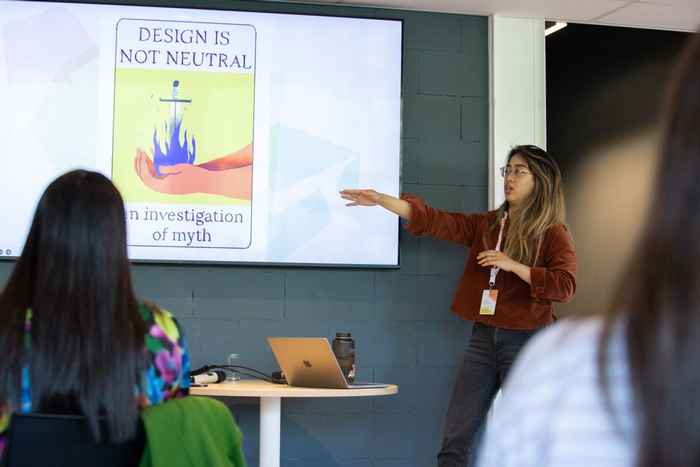
There were lectures and discussions about algorithms and influence. The event also addressed possible harm to consumers, such as violations of privacy, loss of freedom and impact on mental wellbeing.
That confrontation with partners from practice helps science, says Strycharz. It led to intense discussions about harm, especially with representatives from companies such as Google, who use personalisation daily:
“They asked themselves: can you measure this harm? Isn’t this mainly a theoretical discussion? Those are valid questions. They help us as researchers to better see where evidence is still missing and which forms of harm we need to study more closely.”
In this way, the Consumer Empowerment Project brings science, policy and practice together. The aim is not to convince each other, but to jointly look for ways in which digital technology can be used more fairly and more humanely.
Keeping pace with digital innovation
As long as the mechanisms behind data collection remain largely invisible to users, anyone can be digitally vulnerable. Strycharz concludes: 'If we want technology to help us instead of exploiting us, consumer rights must keep pace with digital developments. That starts with fairness in design.'