New book reveals what ASML can teach us about innovation
3 July 2026
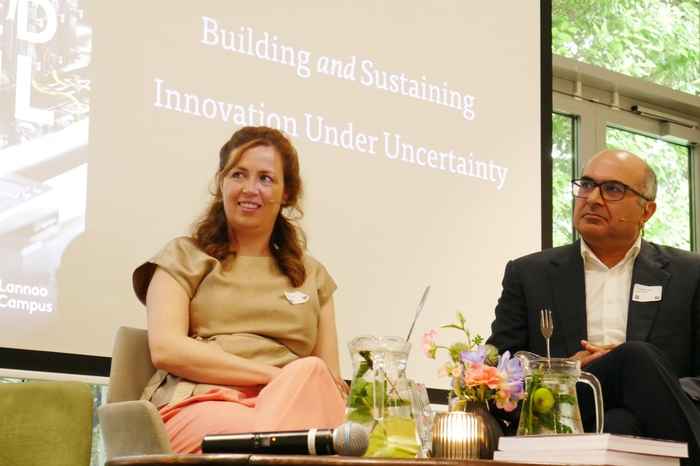
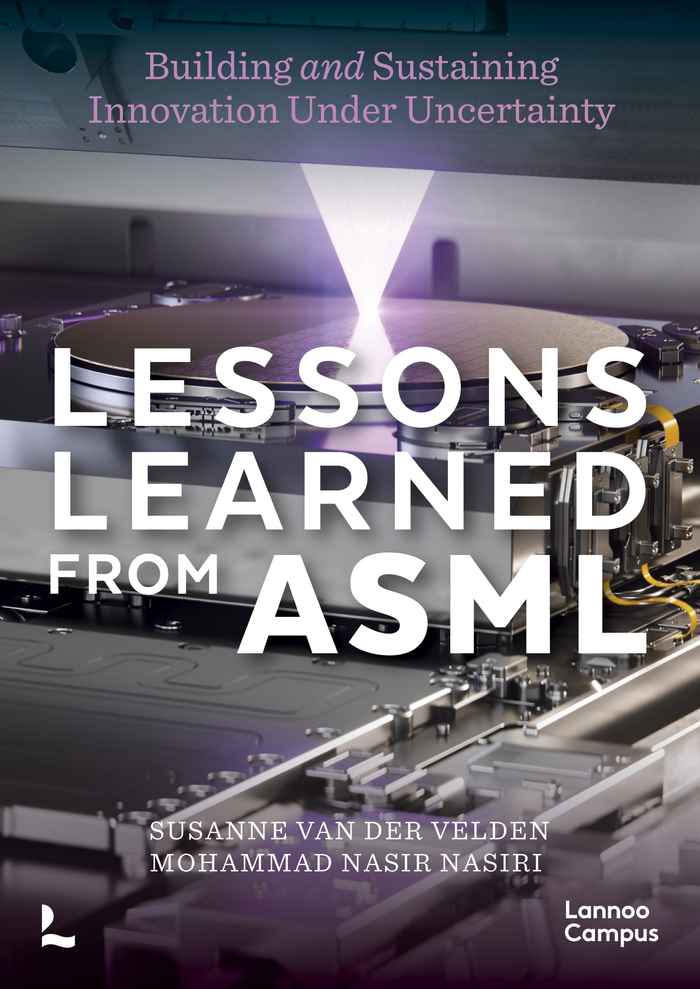
ASML has grown into the most valuable company in Europe and now plays a key role in the global chip industry. In the new book Lessons Learned from ASML, Mohammad N. Nasiri and Susanne van der Velden describe how the company managed to achieve that position.
The authors presented their book at Mikrocentrum in Veldhoven, close to ASML’s headquarters. Nearly one hundred attendees gathered for the event, where researchers, managers, former ASML employees, entrepreneurs and innovation experts discussed what others can learn from ASML.
From underdog to global player
When Van der Velden and Nasiri began their research, they could not have foreseen how important ASML would become on the world stage. The company makes machines for the production of semiconductor chips. These advanced chips have since become indispensable and are now a key element in the geopolitical competition between Europe, the United States and China.
For their book, Van der Velden and Nasiri conducted more than 10 years of research. They carried out extensive interviews and consulted various historical sources. In Lessons Learned from ASML, they reconstruct how ASML developed from a relatively unknown player into a global leader in the high-tech industry.
The book focuses above all on the strategic choices behind that success. What did ASML invest in? How did the company work with customers, suppliers and partners? And how did ASML stay on course during periods of crisis, technological uncertainty and fierce competition?
Not a blueprint, but a case to learn from
According to the authors, ASML shows that technological breakthroughs alone are not enough. Successful innovation also requires long-term investment, clear choices and a culture in which collaboration is central.
'The world needs innovative solutions to complex problems. ASML is not a blueprint to be copied, but it is an example and a case to learn from for companies in Europe that want to grow into global leaders,' Van der Velden said during the book launch.
This means the book is not only relevant to the semiconductor industry. Entrepreneurs, directors, managers and policymakers can also draw lessons from it, the authors argue.
Four lessons from ASML
During the book launch, Nasiri explained that he and Van der Velden formulated 4 central questions to better understand ASML’s remarkable success. The first question examined how ASML managed the technological and business challenges when choosing the next generation of lithography technology. The second broadened the perspective to the wider semiconductor ecosystem, exploring how ASML collaborated with knowledge institutions, suppliers, chip manufacturers and policymakers. The third question addressed how a relatively young company developed the capabilities to make sound strategic decisions and play a constructive role within the industry. The fourth question emerged from conversations with interviewees, who repeatedly pointed to the role of 'luck'. This led the authors to investigate how ASML managed to turn both windfalls and setbacks into opportunities for success.
Van der Velden focused on the third question - what truly makes ASML ASML - and highlighted 4 principles that are central to the company’s approach:
- Strengthening customers’ competitive advantage
- Continuously investing in research and development
- Holding substantive discussions based on facts and evidence
- Focusing on what the company does best
The first 2 principles demonstrate how ASML commits to technology and innovation for the long term. The company developed distinctive technologies for its customers and continued to invest heavily in research and development, even when the future was highly uncertain.
The third principle concerns fostering an open dialogue based on evidence. At ASML, ideas are judged on their merits, not on hierarchy. 'Even if you are an engineer having a discussion with your supervisor, that does not matter. ASML has a learning culture aimed at bringing the best ideas for customers to the surface,' Van der Velden explained.
The fourth principle revolves around focus: excel at what you do best, and collaborate with partners for everything else. This philosophy shaped ASML from the very beginning. The company was founded in 1984 as a spin-off from Philips and built an extensive network of partners and suppliers from the outset.
Collaboration and trust
During the book launch, former ASML employees and innovation experts also underlined the importance of collaboration. Frits van Hout, an ASML employee from the very beginning and former Chief Strategy Officer, discussed this with Tom van der Horst, Business Director for Strategy, Industry and Innovation at TNO, and Albert Maas, founder and CEO of the scale-up Avular. Together, they discussed, among other things, how the Netherlands can organise innovation more effectively. The role of investment was also addressed, including the question of how pension capital can contribute to innovation and Dutch start-ups.
Gerard Kleisterlee, former President and CEO of Philips, articulated an important lesson from ASML’s history from the audience: 'ASML’s motto has always been that if someone else can do it better, and they are not a competitor, you let them do it.' According to Van Hout, that attitude requires trust. 'You have to do it together and dare to entrust things to others.'
About the Authors
Dr M.N. (Mohammad) Nasiri is an Assistant Professor at the UvA's Amsterdam Business School, where his research focuses on Innovation & Technology Ecosystems. Susanne van der Velden is a freelance consultant who obtained her PhD last year with the doctoral thesis Wavelengths: Unravelling the Innovative DNA of ASML.
Lessons learned from ASML is available from Lannoo Publishers.