Highlights from the alumni event on digital sovereignty and Big Tech
13 October 2026
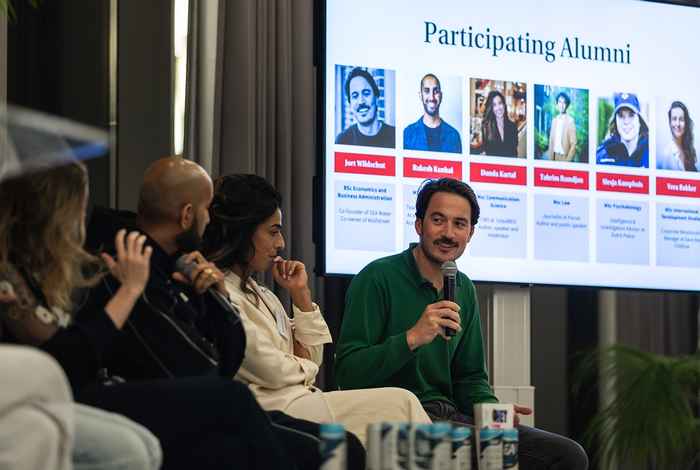
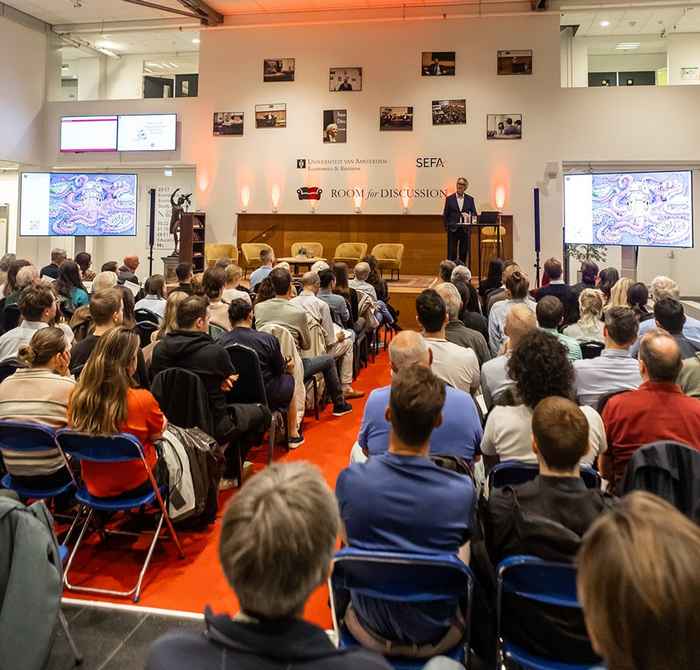
Academics and industry experts discussed these questions on 7 October at the UvA Economics and Business alumni event.
The evening featured a keynote by Maarten Pieter Schinkel, Professor of Competition Economics and Regulation in the Microeconomics section at the Amsterdam School of Economics (ASE). This was followed by a panel discussion chaired by Professor Edo Roos Lindgreen of the Accounting section at the Amsterdam Business School (ABS).
In his opening remarks, Dean Roel Beetsma emphasised that digital sovereignty is about more than technology. It also concerns public values, innovation ecosystems, governance and education. The leaders and policymakers who will make decisions about our digital infrastructure are being educated at university today.
Big Tech as an octopus
Schinkel used an image that has been around for more than a century: the octopus. Once a symbol of oil giant Standard Oil, which was eventually broken up, its tentacles now represent Big Tech’s market power and the many services brought together within a single company.
According to Schinkel, efforts to loosen this grip have achieved too little so far. Europe has pursued competition cases and introduced new rules, such as the Digital Markets Act, but no break-up has followed. A telling example came in 2025, when the European Commission fined Google €2.95 billion for abusing its dominant position in advertising technology. The share price of its parent company Alphabet simply continued to rise. Occasional fines are therefore not enough. Structural interventions are needed, Schinkel argued.
Schinkel outlined a 3-step approach. First, separate a platform’s core function. At Alphabet, such a ‘smart cut’ would separate Search, Maps and YouTube from the commercial services surrounding them. This would preserve the benefits of network effects while opening the rest of the ecosystem to competition. Next, enforce open standards, interoperability and data portability to make switching providers easier. Finally, encourage the development of competing alternatives.
Scaling up and expanding choice
The panel picked up on this final step. Roos Lindgreen invited Myrthe Hooijman, Paul van Vulpen, Martijn Dekker and Harmenjan Sijtsma onto the stage. Together with Schinkel, they discussed how Dutch and European tech alternatives could gain a stronger foothold.
Hooijman works at Techleap, which helps Dutch start-ups and tech companies scale up. Europe has no shortage of technological expertise, she said. What it lacks is the ability to scale up, partly because of insufficient funding. Schinkel pointed out that European companies also struggle to win customers away from Big Tech. According to Hooijman, governments can play a role by choosing European alternatives as customers.
Paul van Vulpen, Assistant Professor of Information Systems at ABS, also addressed this demand side. By working together, for example within a sector, organisations can pool and align their demand (harmonising demand). This can help local tech initiatives get off the ground. Educational and research institutions already do this through the ICT cooperative SURF, Van Vulpen noted.
Martijn Dekker, Chief Information Security Officer at ABN AMRO and a professor in ABS’s Business Analytics section, emphasised the importance of freedom of choice. Having options reduces dependence. This is why ABN AMRO entered into a strategic partnership with the French AI company Mistral. Harmenjan Sijtsma demonstrated that it is possible to use AI entirely within Europe. His company EU GPT runs AI on local servers and European clouds. He called for stricter regulation to protect our data.
A challenge for the UvA
An alumnus in the audience set UvA Economics and Business a challenge: encouraging more European tech companies means fostering entrepreneurship among students, and not just through theory. Dean Beetsma fully agreed. He pointed to challenge-based education, in which students work on real business problems. He said UvA Economics and Business intends to place greater emphasis on this approach in the period ahead.
This brought the evening back to its starting point. The university provides not only the knowledge needed to regulate Big Tech more effectively, but also the people who will build the alternatives.