A new agenda for economics centred on wellbeing
Nicky Pouw’s inaugural lecture on wellbeing economics
3 November 2026
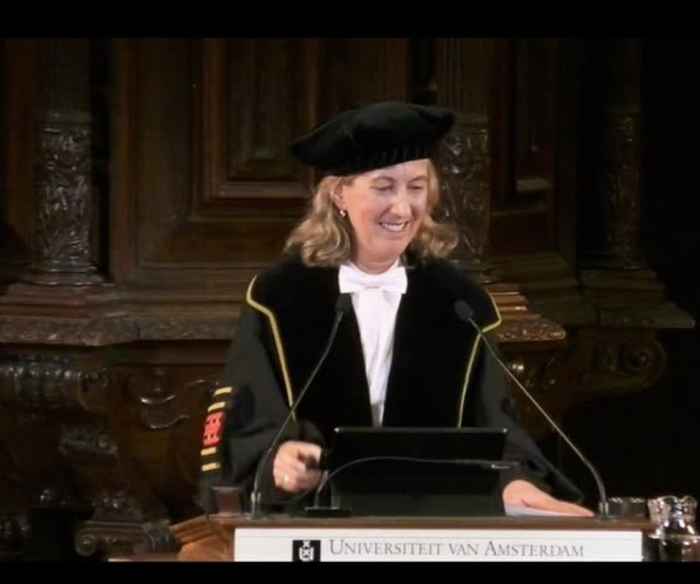
Is economics primarily concerned with pursuing greater material prosperity, growth and productivity? Or with the conditions in which people create a better life for themselves and the planet? According to Nicky Pouw, a narrow focus on economic indicators comes at the expense of attention to what really matters: human wellbeing. ‘Money is a means, not an end. And prosperity is not the same as wellbeing. Wellbeing is about people having the opportunities to pursue their own goals and enjoy a good quality of life.’
In her inaugural lecture, What Counts? Reorienting Economics Around Human Wellbeing, Pouw presented a new agenda for economic research from the UvA’s Faculty of Economics and Business. The agenda highlighted dimensions of wellbeing that have so far received too little attention. ‘Wellbeing has a material dimension, such as income, housing and wealth. But social aspects also play a role. Think of social connections, mutual support and social acceptance. There are also personal factors, including health, a sense of safety, satisfaction and ambition.’
Livelihood security as a central theme
According to Pouw, a wellbeing perspective offers new insights into 1 of the most urgent issues of our time: livelihood security. ‘An increasing number of people are not living in poverty according to the standards and measurement methods economists generally use. Yet they feel that the ground could give way beneath their feet at any moment. For example, because energy bills rise overnight, contracts are terminated without warning and debts keep mounting.’
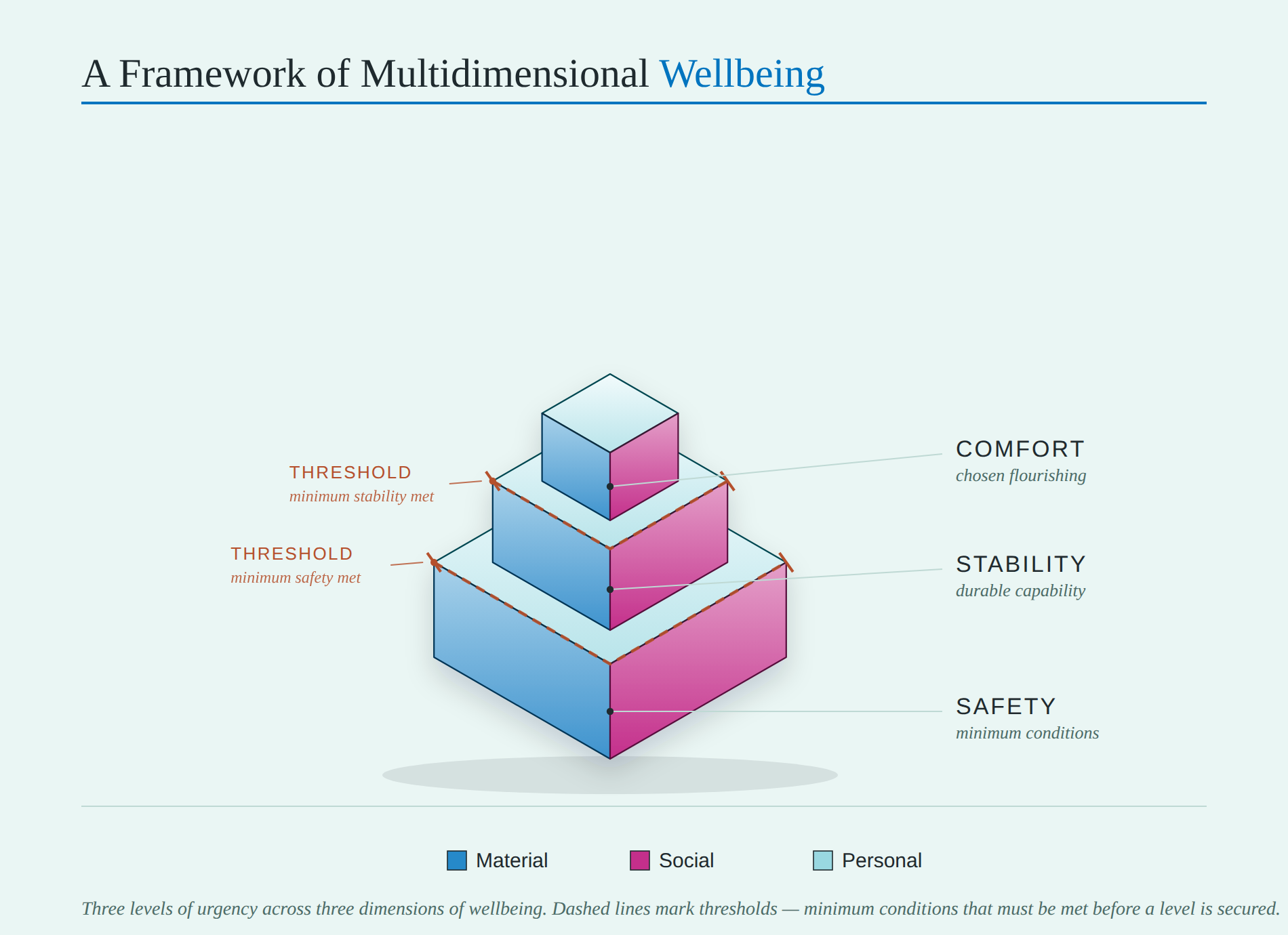
The standard indicators used in economics focus on incomes, the poverty line and the unemployment rate. As a result, they overlook factors that are at least as important to people’s wellbeing. These include a stable home, a safe neighbourhood, support from loved ones and mental health. ‘Wellbeing economics takes account of 3 pillars: people’s material, social and personal circumstances. All these aspects matter. They influence each other and the economic choices people make. For example, substantial debts put pressure on your sleep, health and family life.’
Evidence-based tools for practice
Pouw studied economics at the UvA and obtained her doctorate at Vrije Universiteit Amsterdam. She is scientific director of the Amsterdam Social and Economic Wellbeing Research Centre (ASEWeBe). The centre is developing a new economic paradigm that puts human wellbeing at its heart. Its interdisciplinary team works with residents, civil society organisations and policymakers. It connects academic research with local issues concerning livelihood security and wellbeing.
‘We make livelihood security measurable, and we do so in a way that goes beyond traditional economic research,’ Pouw explains. ‘This produces evidence-based, practical tools that reflect people’s everyday experiences. The wellbeing economics framework also provides insight into the trade-offs people make in financial, social and personal matters. This enables local authorities to explain their policy choices more clearly.’
Wellbeing dashboards for residents and policymakers
In her inaugural lecture, Pouw discusses the research conducted by Welzijnsdashboards Amsterdam (Amsterdam Wellbeing Dashboards) in detail. In this project, the UvA is developing wellbeing dashboards with residents of 6 neighbourhoods in Amsterdam Zuidoost and Nieuw-West, at their request. These dashboards show how residents are doing, based on indicators and topics they choose themselves.
The wellbeing dashboards give residents a voice in developing policy interventions. ‘Only 41% of the indicators in the neighbourhood dashboards are currently included in the City of Amsterdam’s official databases. The remaining 59% is a blind spot in policy. Using the dashboards’ figures and methods, the city and other organisations can find solutions that genuinely make a difference to a particular neighbourhood. Because what you measure determines what receives attention.’
Policy for livelihood security and wellbeing
According to Pouw, the initial findings from Amsterdam Wellbeing Dashboards show that livelihood security is a foundation everyone needs to have opportunities for a good life. ‘Basic security is a minimum requirement in every dimension of wellbeing before you can experience stability and comfort. Without it, you face tragic choices. Do you pay the rent, for example, or buy food?’
The challenge for policy is to look beyond traditional economic statistics, which often focus on averages, Pouw argues. ‘A wellbeing perspective at neighbourhood level helps determine the right order for policy interventions. Community activities, cultural facilities and civic participation are valuable for vulnerable neighbourhoods. But residents’ wellbeing will not improve in a lasting way unless livelihood security is guaranteed first. Social acceptance, income, housing, safety and freedom from chronic stress come first.’
Theory, practice and policy
Through publications and presentations, Pouw and her team share the latest insights into livelihood security and wellbeing. ‘We are working with the City of Amsterdam to explore how the wellbeing dashboards can complement the methods used by its Research and Statistics department. We are also involved in plans to use the dashboards on an ongoing basis in all Amsterdam neighbourhoods. In addition, we provide input for interventions by neighbourhood alliances.’ Other local authorities are also interested in the wellbeing dashboards’ methods and approach. There is international interest too, including from Spain, Wales, Scotland and New Zealand.
In her inaugural lecture, Pouw outlines a research agenda that brings together theory, empirical research and institutions. Economic theories are important for a better understanding of the various issues surrounding wellbeing. A key question in behavioural economics is how behaviour changes when people approach or fall below a threshold. Why does 1 person freeze while another fights, gambles or flees?
Empirical studies are needed to obtain the right data. An example is the participatory, long-term research conducted by Amsterdam Wellbeing Dashboards. This produces representative, credible data that people trust and that can be collected on a larger scale. Institutions then need to embed this research data in their work. This means supplementing the statistics they use with local priorities, measures, budgets and evaluations.
Pouw sees a particular responsibility for economics in this process. ‘The major challenges of our time call for economists who take their own research methods seriously. At the same time, they need to work closely with other disciplines and with the people in society whose lives are at the heart of these issues.’
Nicky Pouw delivered her inaugural lecture on 29 October 2026 in the Aula of the University of Amsterdam. You can watch a recording of the full ceremony and inaugural lecture on the UvA website.