Vossius Research Fellow: Claudia Cristalli
11 November 2026
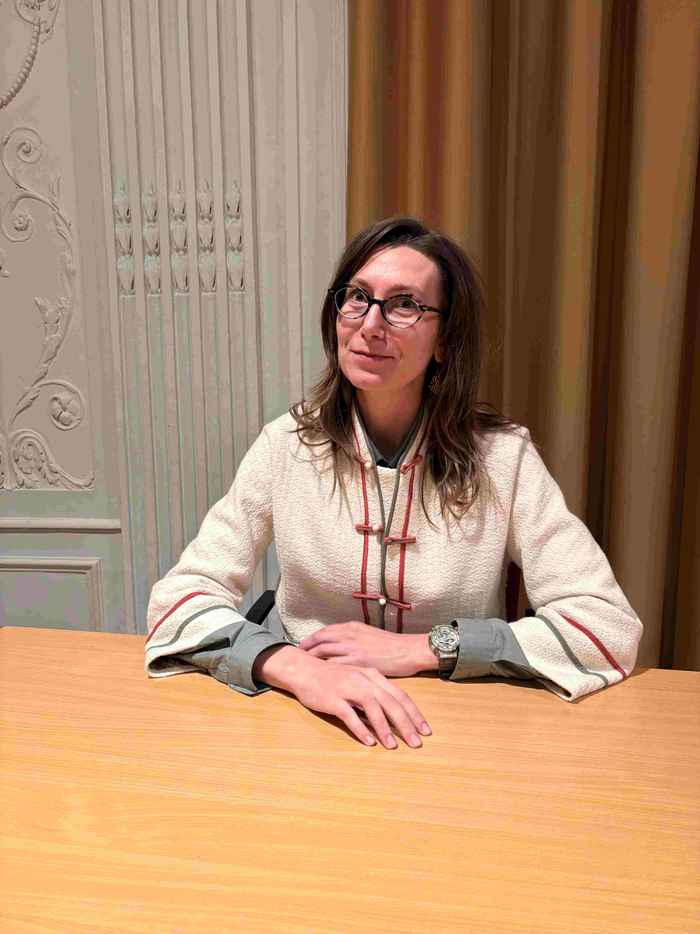
About Claudia Cristalli:
Claudia is a historian and philosopher of science with a background in American pragmatism, particularly Charles S. Peirce. She has always been interested in how scientific practices shape and are shaped by philosophical assumptions of what there is and by our values. Her first book, Peirce’s Philosophical Psychology, comes out in January 2027 with Cambridge University Press. Claudia’s interest in the history of psychology (including psychical phenomena!) and the philosophy of science goes hand in hand with her fascination for reconstructing and re-enacting psychological experiments. Articles focusing on reconstructing historical experiments and what we can learn from this practice appeared on Nuncius and Berichte zur Wissenschaftsgeschichte. She is currently editing a special issue on the topic for History of the Human Sciences. She welcomes opportunities to collaborate with museum curators, artists, and educators.
Project description:
My project aims to bring reconstruction and re-enactment of historical instruments in psychology on the agenda of mainstream historians and philosophers of science as a viable and desirable research practice. While reconstruction has indeed played an important role in scholarly practices in the history of the “hard” sciences, most notably physics and chemistry, but including medicine and pharmacology, psychology and the human sciences have been lagging behind, with some exceptions. Reconstruction offers the opportunity to gain a deeper awareness of the limits of our “know that,” as well as contextually specific “know how.” Reconstruction is inherently collaborative and transdisciplinary, in that it mobilizes several competences (conservation and engineering skills, historical research, philosophical analysis, and embodied performances) and it cannot be carried out in isolation.
During my stay at the Vossius centre, I will focus on a set of pressure balances now part of the instruments collection at the Groningen Psychology Museum: the balansen voor drukgewaarwordingen n. 34-37 (Draaisma 1992, 125-6). These instruments use scales or lever mechanisms to convey varying degrees of pressure on a subject’s fingertip. My first acquaintance with an instrument of this kind comes from an experiment where the researchers used a modified post-office scale to investigate perception without awareness (Peirce and Jastrow 1885). This experiment did not receive much publicity and was considered “advanced” by manuals of the time. While originally carried out in the United States, I was not able to find any other instances of similar instruments in the country. Surprisingly, the Groningen psychology laboratory included four instruments that appear related to the earlier pressure balance.
I will investigate whether there is any historical connection between the different sets of balances, and what were the Groningen ones used for. Through the study of archival material, I aim to trace the diffusion of pressure balances and the direction in which they travelled. If possible, I will also familiarize myself first-hand with the working of these different pressure balances or construct suitable replicas. My goal is to understand how the particular configurations of the instrument responded to and fostered specific understandings of the phenomena under study. This means making the rhetoric and language of instruments explicit. Conversely, instruments and their related methodologies opened distinct research possibilities, which become apparent through reconstruction. The outcome of this research will be a paper for Isis, and a grant proposal on the long history of psychological instruments measuring sensation across the conscious-unconscious line.