Beyond the Technical Fix: Water and Housing Transformations in Ghana
Written by Saee Mandhare
29 June 2026
Yet across both talks, the same underlying theme emerged: reimagining and transformation. Rather than treating water systems and housing as fixed, finished things, both speakers showed how they are constantly being rethought, adapted, and reshaped by policy, by institutions, and by the people who live with them every day.
The seminar featured visiting scholars Dr Florence Abugtane Avogo and Dr Nicholas Fielmua from SD Dombo University of Business and Integrated Development Studies in Wa, Ghana. Their visit was supported through an Erasmus+ staff and student exchange grant, creating an opportunity for knowledge exchange between colleagues working on questions of housing, water governance, and development. The programme also included a contribution from our colleague, Dr Rowan Arundale from the GPIO department.
Transformation, one home at a time
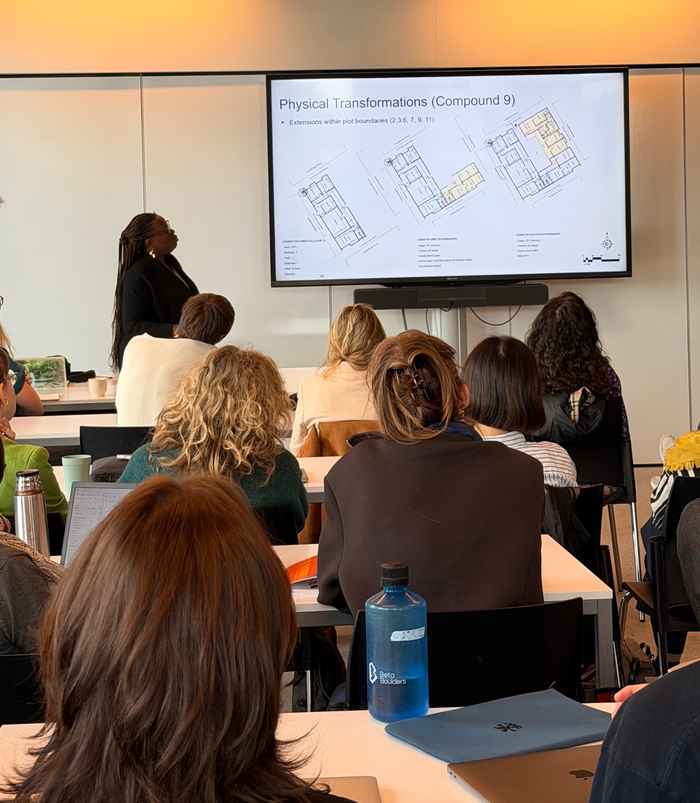
The first talk, by Dr Florence Abugtane Avogo, drew the focus to housing in Wa, Ghana, and the everyday ways families adapt their homes over time. Despite various interventions, affordable, decent housing for low-income urban dwellers remains out of reach for many. To better understand how people respond to this challenge, the talk turned attention to compound or courtyard housing: a traditional housing form that has long accommodated extended families but is gradually losing prominence as lifestyles and aspirations change.
Dr Avogo's research explored how these houses are being transformed from within. Rather than passively occupying inherited spaces, families continuously negotiate and adapt their homes to meet changing needs. Shifts in household size, economic circumstances, and cultural expectations have led to physical alterations such as extensions, room reconfigurations, and the subdivision of living spaces. At the same time, these changes reflect broader transformations in family life and domestic organisation. A key finding was that many older compound house designs no longer fully meet contemporary housing needs. As a result, residents have developed their own solutions, often incrementally modifying homes to create greater privacy and independence. Many of these transformations result in single-family units, suggesting a growing preference for nuclear-family living arrangements in future housing provision.
Yet these changes do not simply replace one housing model with another. Instead, they produce hybrid forms of living that combine elements of traditional communal housing with newer expectations around privacy, autonomy, and family life. What stood out throughout the presentation was the resilience of social relationships. Even as the physical structure of compound housing evolves, kinship ties and systems of mutual support often remain intact. The architecture may change, but the social bonds that sustain everyday life continue to endure.
Reimagining water management
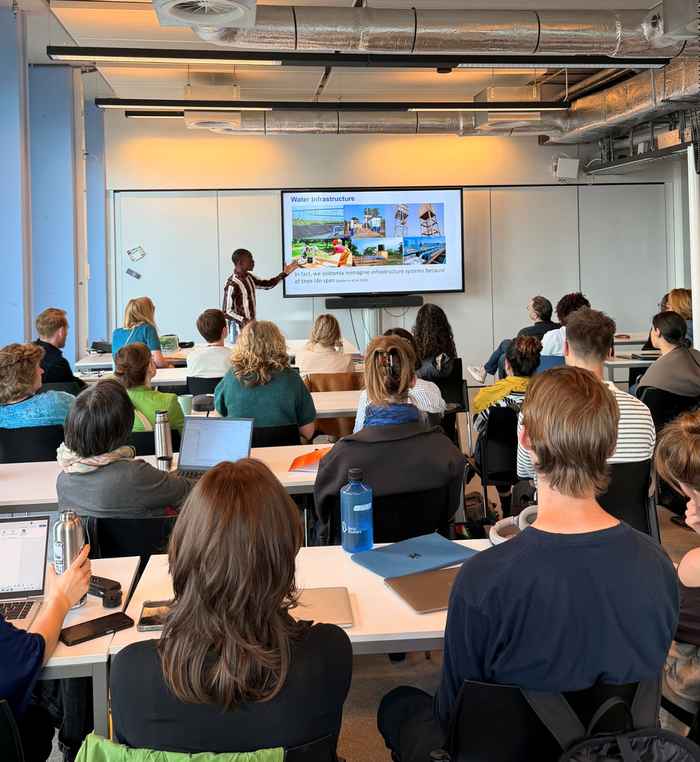
The second talk, led by Dr Nicholas Fielmua, looked at water infrastructure in Ghana. Water governance, he argued, has long been approached primarily as a technical problem — get the pipes right, and the system will work. His talk invited us to reimagine this: infrastructure on its own is not enough, and institutions and governance arrangements matter just as much as the physical systems that deliver water to communities. Rather, water systems depend on both physical infrastructure and the institutions that govern, maintain, and adapt them over time. As Dr Fielmua put it, water management is like an animal that walks on two legs: infrastructure and institutions must move together.
A central theme of the talk was the need for long-term thinking. Effective and efficient water management is not achieved through one-off investments but through sustained planning, political commitment, and governance arrangements that can endure beyond short-term priorities. This requires an unconditional societal and political commitment to water provision, alongside technical policies that are responsive to changing circumstances.
Trust emerged as another crucial dimension of water governance. Growing demand for water, competing uses, and concerns about pollution mean that access alone is not enough; people must also have confidence in the quality and reliability of the water they receive. Building this trust extends beyond the work of engineers and infrastructure planners, requiring insights from social scientists, behavioural researchers, and communities themselves.
The presentation concluded with a broader reflection on resilience. New infrastructure should not automatically be equated with improved access to water. A resilient water system can navigate social, environmental, and institutional pressures while continuing to function over time. Achieving this requires moving beyond familiar approaches and recognising that sustainable water management depends as much on governance, trust, and long-term commitment as it does on engineering solutions.
GIS as a research tool
The seminar also included a contribution from Dr Rowan Arundale, who spoke about the GIS lab and its role in supporting research. Beyond an introduction to the lab's capabilities, the discussion that followed had the audience reflecting on how GIS tools could be applied to their own research, another small example of reimagining: taking an existing tool and thinking through what it could open up for different kinds of work.
A shared theme
Although water infrastructure, housing, and GIS cover a broad range of topics, all three contributions pointed to the same underlying idea: reimagining and transformation. Whether it's rethinking how water systems are governed, watching how families gradually reshape their homes over generations, or imagining new uses for a research tool, the seminar was ultimately about how everyday systems such as pipes, houses, and even research methods are never fixed. They are constantly being reimagined and transformed by the people and institutions that use and interact with them.