The Weight of Silence
Annual Lecture by Farhana Sultana
21 July 2026
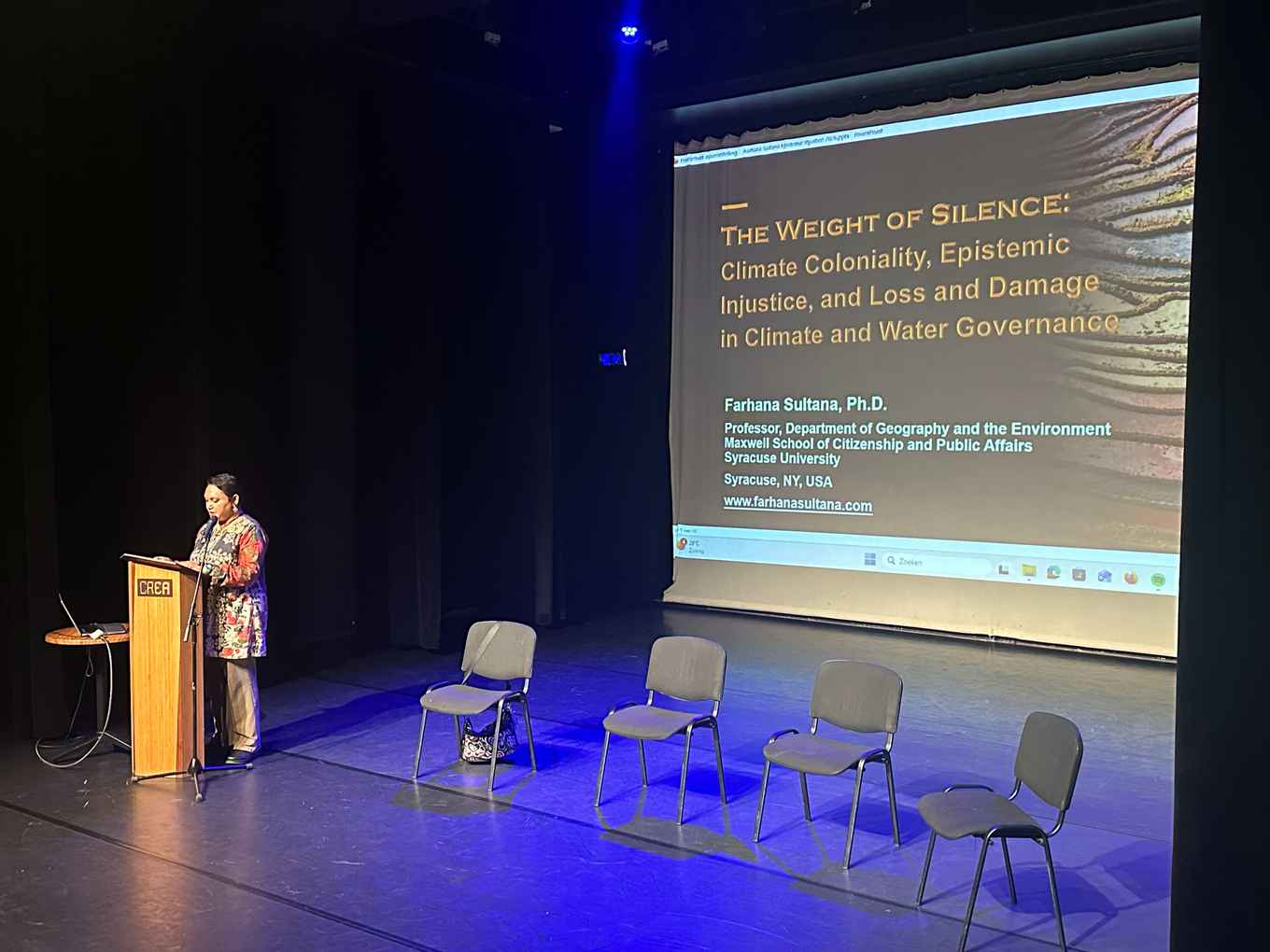
Professor Farhana Sultana, from the Maxwell School at Syracuse University, spoke at the CREA Theatre Hall, followed by a panel with Dr Amitangshu Acharya (IHE Delft), Dr Ethemcan Turhan (University of Groningen), and Dr Karen Paiva Henrique (University of Amsterdam). Together, they reflected on how climate coloniality, epistemic injustice, and loss and damage shape contemporary climate and water governance.
Climate Coloniality at 37ºC
Sultana’s intervention began from a clear premise: climate change is not a standalone crisis. It does not create inequality anew; it intensifies inequalities that already exist, and it often does so through water. Droughts, floods, sea-level rise, and contamination are not abstract scenarios but everyday realities for millions of people, especially in the Global South. If climate change arrives as water, then understanding climate change means understanding water change – and that requires reckoning with the colonial architectures that still determine who can adapt, under what conditions, and at whose expense.
This perspective unsettles the tendency to treat adaptation as a purely technical problem solvable with more data, better tools, or increased funding. The deeper issue, Sultana argued, is structural: centuries of colonial extraction and governance have produced a world in which those least responsible for greenhouse gas emissions are the most exposed to climate impacts and the least equipped, institutionally and politically, to respond. Technical solutions that leave these structures untouched risk reproducing, rather than addressing, injustice.
A significant part of the lecture focused on loss and damage, a concept gaining traction in international climate negotiations. Sultana drew attention to what is routinely left out of official assessments: non-economic losses. These include the erosion of cultural identity, the loss of place and belonging, and the disruption of social relations and ways of life that resist translation into monetary terms. Water offers a sharp lens here. When communities lose access to water through drought, displacement, contamination, or privatisation, they lose not only a resource but also a right. As Sultana stressed, framing water as a human right is not just a legal move; it is a political claim continually contested along colonial and postcolonial fault lines.
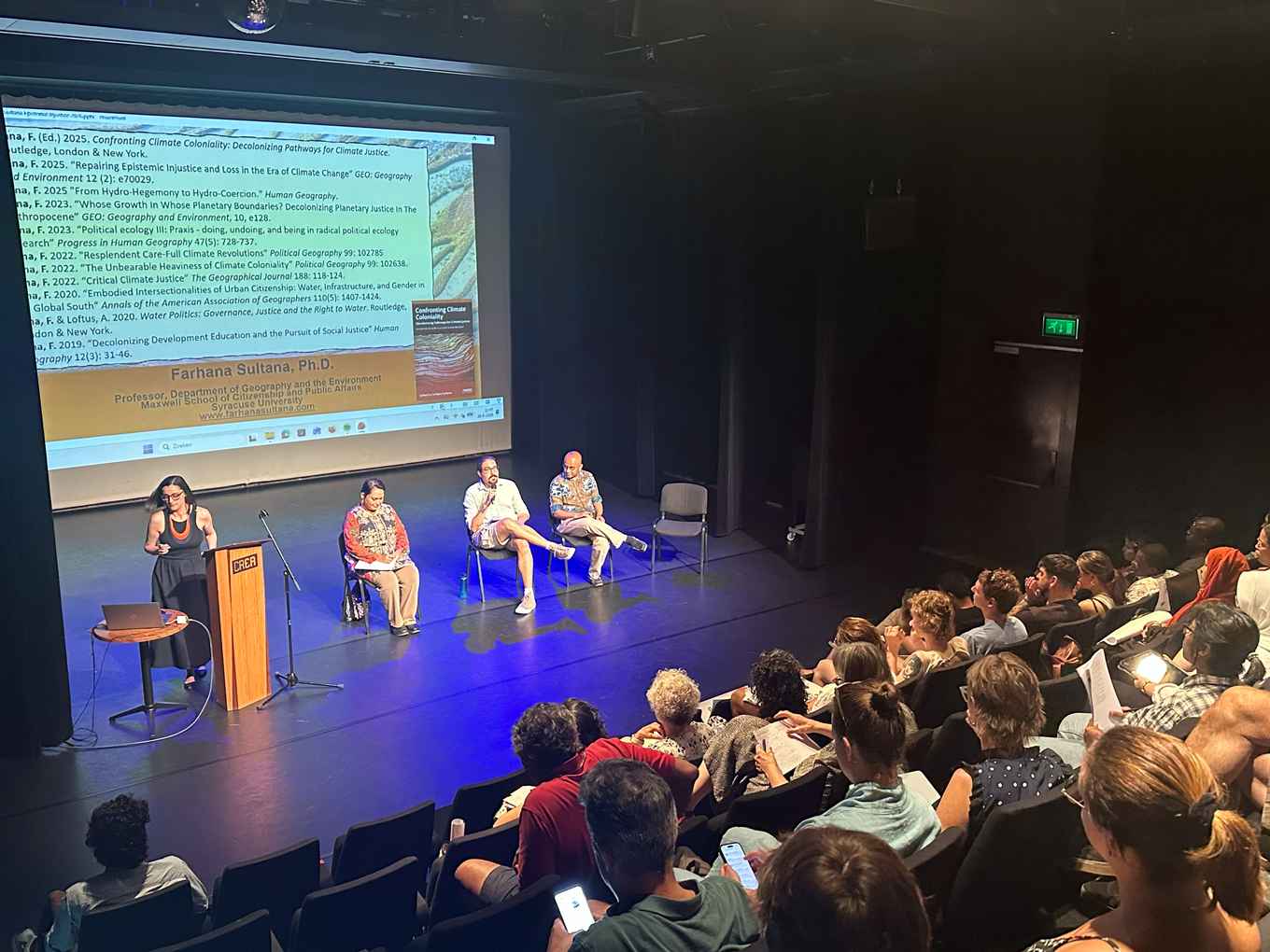
Confronting epistemic injustice in a theatre hall
The lecture then turned to epistemic injustice, that is, the systematic devaluing or erasure of certain forms of knowledge. Sultana highlighted how epistemic infrastructures such as institutions, disciplines, and policy frameworks generate epistemic silences by rendering some experiences unintelligible or irrelevant. Testimonial injustice occurs when people’s accounts are discounted because of who they are. Hermeneutical injustice arises when dominant concepts and frameworks are incapable of capturing particular experiences. These intertwined injustices map closely onto global power asymmetries, reinforcing whose knowledge counts and whose does not.
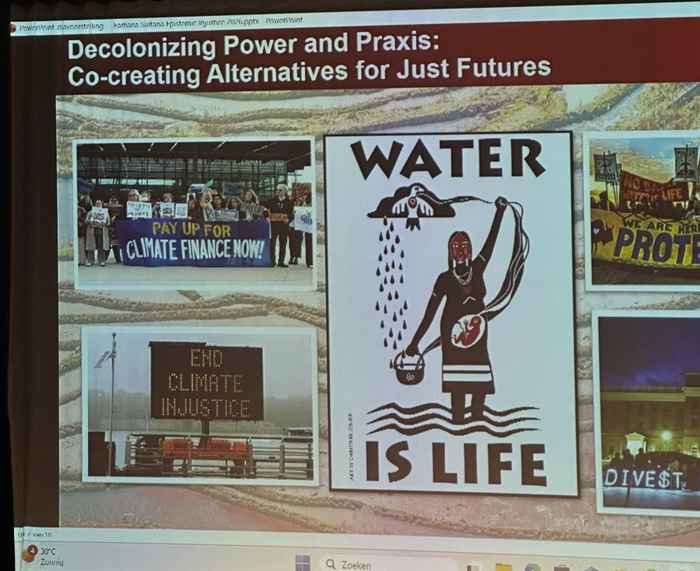
Against this backdrop, Sultana called for decolonisation not as metaphor but as political practice. Decolonising climate and water knowledge is about more than inviting diverse voices into existing frameworks; it means questioning those frameworks themselves and creating conditions in which communities become agents of their own governance rather than objects of external intervention. She offered three guiding principles for this work: refusal, resurgence, and relationality. Refusal involves declining to participate on terms set by unjust systems and rejecting depoliticised narratives of crisis. Resurgence points to reclaiming and revitalising suppressed ways of knowing and being, including Indigenous and local knowledge traditions. Relationality foregrounds the entanglement of human communities with the more-than-human world, a view central to many Indigenous epistemologies and long-standing debates in political ecology.
Difficult questions with no easy answer
The Q&A session reflected the range of the audience and the urgency of the themes. Participants raised questions about the implications of artificial intelligence for water governance and academic knowledge production, and about the legal case brought by Greenpeace against the Netherlands over climate adaptation policy in Bonaire. That case, and broader debates around Aruba, Curaçao, Sint Maarten, Sint Eustatius, and Saba, highlighted unresolved responsibilities of the Dutch state towards its Caribbean territories. The discussion also engaged with the idea of pluriversality: a world where multiple ways of knowing and being coexist, rather than one dominated by a single universal framework.
All of this unfolded on a 37-degree day in June – a reminder that the conversation was not only about distant futures but about a warming present. Sultana’s lecture underscored that climate justice cannot be delivered through technical solutions alone. It requires confronting the colonial structures that govern those who bear the costs of climate change and whose knowledge shapes our responses. In this account, water is more than a resource to be managed; it is a site where questions of justice, power, and belonging are negotiated, and where the weight of silence can no longer be ignored.