On One Stage: A Theatre Performance
8 September 2026
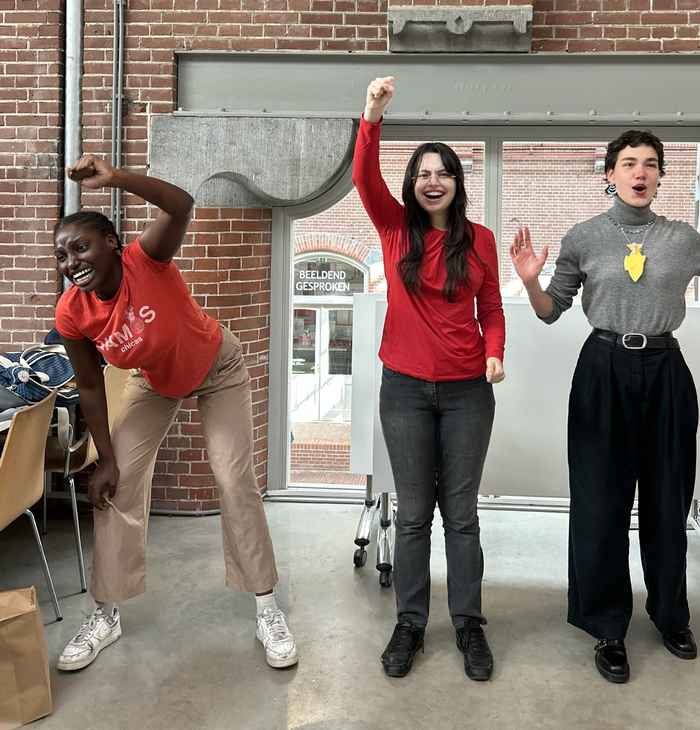
Faculty members and students from UvA were invited to join a theatrical process led and directed by Dr. Chen Alon, a research fellow at ACCS, and a theatre scholar, director, and activist who specializes in theatrical work with groups in conflict, particularly Israelis and Palestinians. Entitled On One Stage, this theatre project drew on the model of Polarized Theatre of the Oppressed, based on the Theatre of the Oppressed of Brazilian Augusto Boal. As a result, it centered on the democratization of the creative process and shared ownership among participants.
A multicultural and multilingual theatre ensemble
A multicultural and multilingual theatre ensemble was formed on campus. Faculty members and students from all degree programs and years of study, representing 12 countries and speaking ten different languages, came together on one stage to explore how personal, social, and political relationships become systems of power and oppression, and give rise to conflicts.
Personal stories and experiences
The encounters gave rise to personal stories and experiences: toxic relationships, sexual harassment, racism, discrimination related to mental health and the autism spectrum, struggles around academic accommodations and adjustments, the oppression of women, body image and the internalization of oppression, freedom of speech and protest, police violence, and more.
A dystopian story
These personal materials were woven together into a dystopian story: Amsterdam is placed under a mysterious curfew. The city gradually closes down, is silenced and falls silent; freedom of movement and expression erode, and the story moves from character to character and from place to place. Yet one persistent narrative feature follows the characters: the transformation they undergo. Those who occupy the position of the oppressed in one situation become the oppressors in another.
Part of the machinery of oppression
A menacing soundtrack accompanies this chain of events, intensifying it until it reaches a breaking point. As the story unfolds, the erosion of personal and collective freedom grows increasingly severe, culminating in a protest in which it becomes clear that oppression is not enacted only by those who exercise power. Those who remained silent, those who looked away, and those who chose not to intervene - to remain "audience" - also become part of the machinery of oppression.
But On One Stage does not end with the performance.
From spectators to 'spect-actors'
At the end of the show, the audience is invited to move from being spectators to 'spect-actors' through Forum Theatre - a technique developed by Augusto Boal in which members of the audience are invited to enter the scenes, replace the characters, and try to act differently in situations of oppression.
In this way, personal stories become artistic material; artistic material becomes a space for shared inquiry and mutual learning; and the audience becomes part of the creation and the action.
What happens when people with conflicting experiences meet
On One Stage is an exploration of what happens when people with different, and sometimes conflicting experiences, meet on one stage - not in order to agree, but to listen, confront, act, and imagine together different possibilities and a different future, both personally and collectively.
Not solidarity as a position or an opinion. Solidarity as action - first on stage, within the aesthetic space, and then in reality.
Watch the video
Curious what this performance looked like? Have a look at the highlights video below: