Sponges use photosynthesis, boosting productivity of tropical coral reefs
1 July 2026
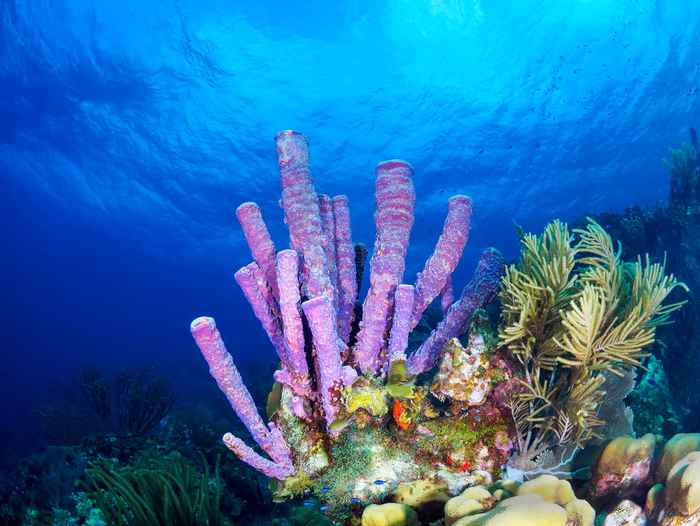
Sponges under the sea
As a benthic ecologist, Michelle Achlatis likes to say she’s studying the sea life that is stuck to the bottom of the ocean, rather than swimming around. And sponges have been a key part of her work over the past years, as she researches their role in the ecosystem.
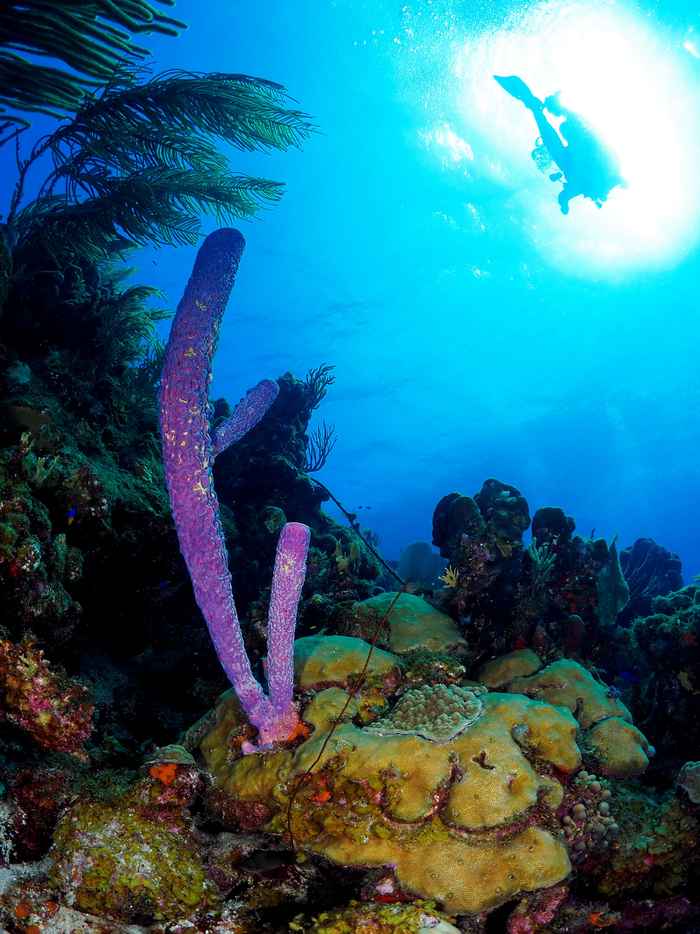
“We call them a textbook example of filter feeding and suspension feeding, because they are not only filtering, but also absorbing all sorts of edible material from the seawater,” said Achlatis, who conducted this research as part of her postdoctoral research at IBED. Specialized cells pump water through their bodies, trapping whatever is edible in the water and “drinking it” to absorb dissolved nutrients.
But sponges also have symbiotic partners. Some of them are tiny microbes that are photosynthetic. They use the energy in sunlight to produce their own food and release oxygen. And while sponges’ photosynthetic properties had been researched before, they had only been tested on a few species. As part of the new study, researchers wanted to look at more sponge species and also scale up the measurements to the ecosystem level.
Sampling sponges
Achlatis and her colleagues assessed 24 of the most common sponge species from reefs around the island of Curaçao. They conducted extensive measurements for eight of these species. They scaled up their findings to the ecosystem level to compare the sponges to other photosynthesizing organisms and to see how much oxygen they were producing at the ecosystem level. To assess the abundance of organisms on the reef, they used a more holistic dataset that looks at the reef in all its three dimensions and that accounts for its richness.
“A previous study found that when you look at the three-dimensional reef, there are so many more sponges there than you expect,” Achlatis explains. “By doing more detailed measurements, you can calculate their volumes.”
The researchers found that half of the sponge species tested accounted for 11% of gross primary productivity, meaning they were important producers of organic compounds for the ecosystem. This was a surprise: Achlatis thought that maybe a fourth or a third would be photosynthetic. She also did not expect how much the sponges contributed to productivity.
“It’s a group that in previous food web studies or big coral reef modelling were always put aside as pure consumers and not producers,” she says. “But they are quite flexible feeders and can supplement with photosynthesis.”
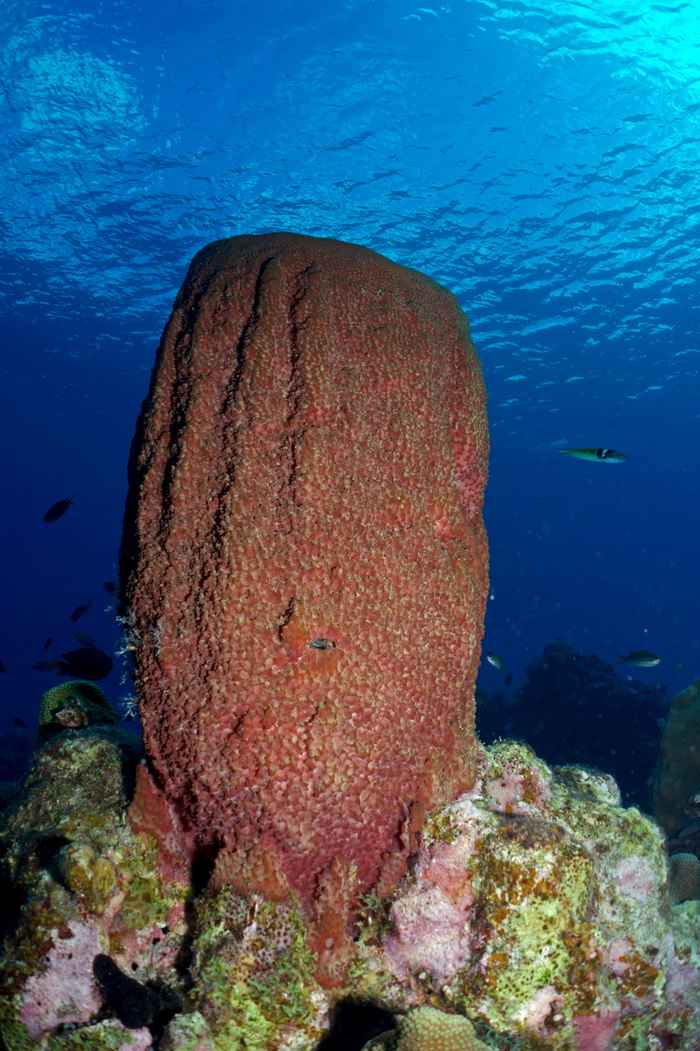
Future directions
This study was conducted in one tropical region. However, sponges in similar regions may have the same photosynthetic components. The results may be applicable across other ecosystems.
And this “multitasking” ability of sponges has larger implications. Sponge-rich ecosystems, like coral reefs, should be added to assessments of carbon sequestration, argues Achlatis.
“The case we are trying to make with this paper is really that people should be aware that sponges are not only recycling carbon and nutrients that they find on the reef, they also have their own ways of making them, even if they're small amounts, comparatively,” she says.
Sponges are not plants but are not animals either, adds Jasper de Goeij, associate professor of marine benthic ecology at IBED and one of the co-authors of the study.
“Together with their symbiotic microbes, sponges can photosynthesize, just like a plant,” he says. “We need to look differently at many organisms living in the ocean, as they do not follow the strict plant-animal distinction as most organisms on land.”