An atom’s interaction with light is not where it is supposed to be
27 August 2026
An optical curve ball
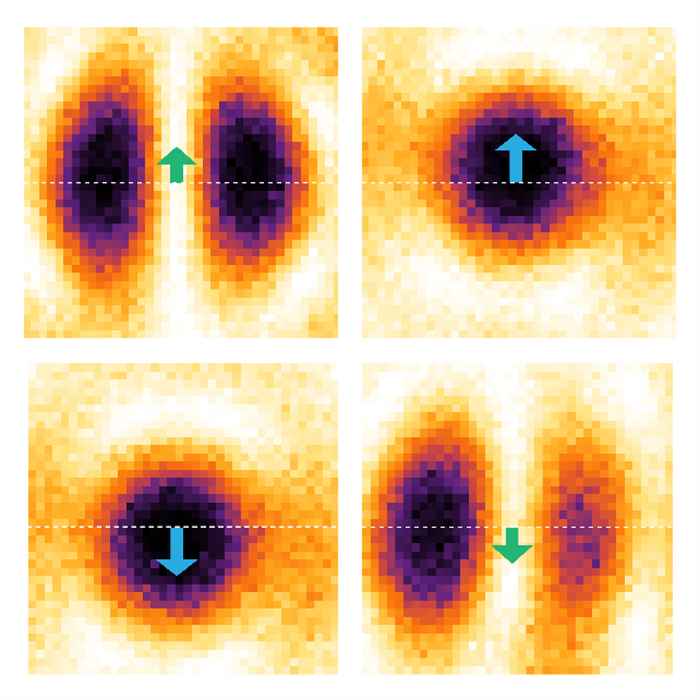
When a football is kicked with spin, it curves through the air. This phenomenon, familiar to football fans, is known to physicists as the Magnus effect. Surprisingly, an atom interacting with a tightly focused laser beam shows a similar effect: the atom behaves like the ball, and the laser light replaces the air that the ball interacts with. The strongest interaction between the atom and the laser occurs slightly away from where the laser itself is centred.
While this optical analog of the Magnus effect was predicted several years ago by UvA scientist Robert Spreeuw [1], it had so far not been experimentally observed. Still, the effect is relevant for atomic physics experiments, where tightly focused laser beams, or optical tweezers, are used to precisely control atoms for quantum computing. In this context, the optical Magnus effect could be a cause of qubit decoherence, the loss of information stored in quantum bits due to their interaction with the environment. At the same time, this ‘bug’ could be turned into a feature: utilizing the optical Magnus effects opens the door for new ways of manipulating qubits [2].
From theory to practice
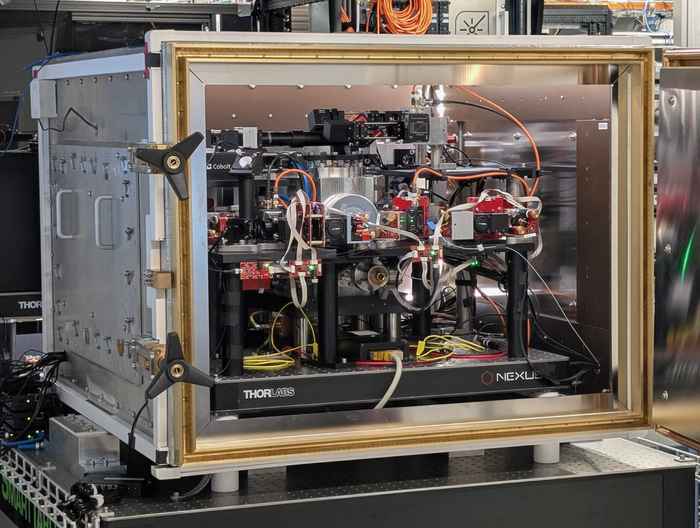
In a study that was recently published in the journal Physical Review Letters [3], researchers at the UvA Institute of Physics collaborated with the Ion Trap Quantum Computing group of the ETH Zurich – PSI Quantum Computing Hub on their experiment to help measure and characterize the optical Magnus effect for the first time. To this end, they used a calcium ion – a single atom with some of its negatively charged electrons removed – as a highly sensitive probe of the light field within an optical tweezer. By adjusting the properties of the ion and the light, the team detected shifts in the atom-light interaction profile of several hundred nanometers – thousands of times larger than the size of the calcium ‘football’ itself.
Earlier theoretical work by the UvA team had shown how this fundamental effect arises due to the tight focusing of a laser beam [4]. With the new experimental results, theory and experiment now nicely align into a good understanding of the optical Magnus effect. The results show a subtle feature of an atom’s interaction with light and establish the physical basis for future work using optical tweezers for quantum gates that can be used in quantum computers.
References
[1] Off-Axis Dipole Forces in Optical Tweezers by an Optical Analog of the Magnus Effect, R. J. C. Spreeuw, Phys. Rev. Lett. 125, 233201 (2021)
[2] Trapped ions quantum logic gate with optical tweezers and the Magnus effect, M. Mazzanti et al., Phys. Rev. Research 5, 033036 (2023)
[3] Direct Observation of the Optical Magnus Effect with a Trapped Ion, P. Leindecker et al., Phys. Rev. Lett. 137, 063202 (2026)
[4] Nonparaxial effects on laser-qubit operations, L. P. H. Gallagher et al., Phys. Rev. Research 8, 013077 (2026)