Corentin Coulais appointed professor in Soft Matter Mechanics
29 October 2026
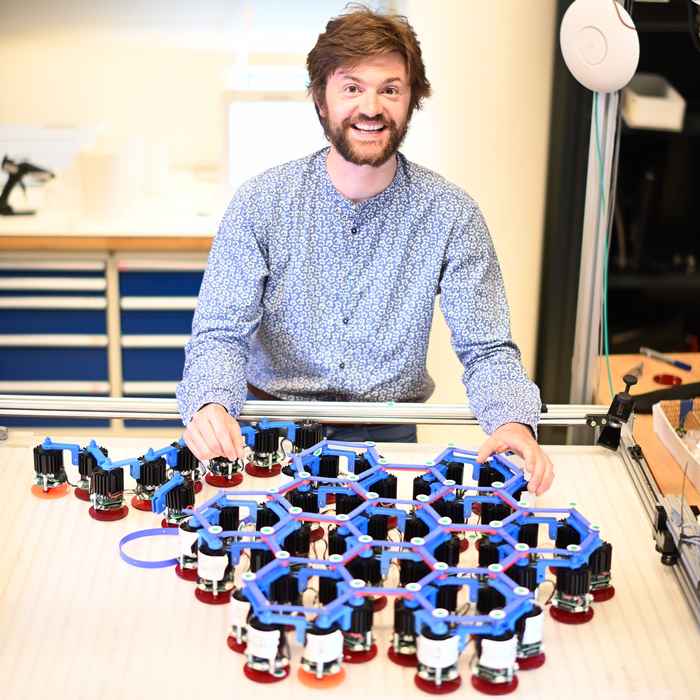
Coulais’ research focuses on the physics of soft structured active materials. Its main goal is to blur the boundary between material and machine: to create artificial materials that utilize instabilities to interact with their environment in a programmable fashion. This leads to new classes of materials with superior damping capabilities and to materials that spring to life and move like living materials do. To achieve this, over the past years Coulais has established an internationally recognised research programme at the interface of physics, materials science and engineering, which has been instrumental in defining the emerging field of active and nonreciprocal metamaterials.
After obtaining his PhD at the CEA Saclay/University Pierre et Marie Curie in Paris in 2012, Coulais was a postdoctoral fellow at Leiden University and AMOLF, before joining the University of Amsterdam in 2017, first in a tenure track position and then as a tenured associate professor since 2021. During this period, he obtained several national and international grants, including personal NWO Veni and Vidi grants and ERC Starting, Proof of Concept and Consolidator grants. He has also obtained multiple grants with industry and recently co-founded a startup, VYTL works, that aims to bring shock absorbing metamaterials to the market.
Coulais is an inspiring teacher and has set up courses on topics of his expertise which are now central components of the soft matter and condensed matter curriculum at the University of Amsterdam. He has trained over a dozen PhD students and postdocs, many of whom went on to become experts in the field themselves, won thesis awards, secured their own grants, and obtained positions in academia and in the high-tech industry. Coulais is also very active in disseminating the results of his work to a broad audience in popular science talks, videos about his research and demonstrations during public events.
As a professor in Soft Matter Mechanics, Coulais intends to create a new type of active materials that can adapt to unforeseen circumstances by mimicking the learning that occurs in living materials and neurons, and at the same time to enhance the properties of dissipative metamaterials using optimization techniques based on AI. On the educational front, he plans to contribute to teaching in mechanics, soft matter and statistical mechanics in the physics and astronomy BSc and MSc and on metamaterials in the newly established Science Technology Innovation BCs.