New project to investigate the source of the record-breaking neutrino detected by KM3NeT
12 October 2026
A record-breaking observation
The proposed research will be a collaboration between the UvA-Institute of Physics, the Nikhef institute for Subatomic Physics and the GRAPPA centre of excellence for Gravitation and Astroparticle Physics. The researchers will receive an ENW-M2 grant to appoint two early-career researchers.
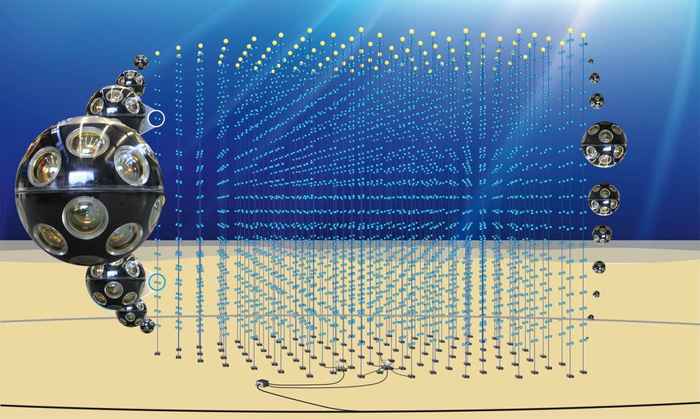
KM3NeT is a large neutrino detector currently under construction at the bottom of the Mediterranean Sea. Nikhef and the University of Amsterdam are closely involved in the project on behalf of the Netherlands; the project seeks both to trace the sources of neutrinos from the universe and to study the properties of the neutrinos themselves. Heijboer, a professor by special appointment at the UvA, was the science coordinator for this international mega-project until recently.
When the cosmic neutrino struck on 13 February 2023, the KM3NeT detector recorded a signal with at least 30 times more energy than had ever before been observed in cosmic neutrinos. Neutrinos are produced in cosmic particle accelerators such as the environments of black holes at the centres of galaxies. Due to their weak interaction, they hardly interact with other matter.
Searching for the source
The record-breaking event KM3-230213A was announced two years later, following detailed analyses, and was published prominently in Nature. However, one key question remained unanswered: what could have been the source of this spectacular particle?
In the OMEN proposal by Heijboer and Ando, a method is proposed to pinpoint the source more accurately. A major limitation of the earlier analyses was that the orientation of the detector relative to the starry sky had not been precisely determined.
Heijboer and Ando now intend to try to identify two reference points in the sky within the KM3NeT measurements: the positions of the Sun and the Moon. To do this, they are using cosmic rays (muons), which normally form the background for the neutrinos. The Sun and the Moon partially shield these particles.
If both reference points can be identified in the detector’s observations, this will make it easier to pinpoint the source’s location in the sky. Consequently, astronomical observations of the relevant region might yet reveal an active source.
OMEN proposal
To make this possible, Heijboer and Ando are, as part of the OMEN (“Origin of the Most Energetic Neutrino”) project, combining insights from the KM3NeT data analysis with theoretical calculations of the trajectories of charged particles, their interactions and their impact on the shadow cast by the Sun and Moon in the KM3NeT measurements.
According to Heijboer, identifying the source of KM3-230213A is also of interest because it could turn out to be the first measurement of the production of neutrinos from intergalactic space. Black holes at the centres of galaxies are usually identified as the source of cosmic neutrinos.
However, in theory, extremely high-energy neutrinos can also be released when cosmic rays – such as protons or atomic nuclei – collide with photons from the cosmic background radiation. Such cosmogenic neutrinos have never been observed before.