Time crystals: moving to an internal beat
14 October 2026
Active time crystals
Crystals occur everywhere in nature. The best-known examples, ranging from beautiful diamonds and gemstones to ordinary table salt, can be considered “spatial” crystals: states of matter that repeat in a regular pattern in space. Lately, physicists have been very interested in an alternative option: that of time crystals, structures that also repeat a pattern in time. For example, an external repeating force can cause a material to resonate and start vibrating in a given frequency, like a crowd at a party moving in sync to the rhythm of a DJ.
Another hot topic in recent physics research has been that of active matter: configurations of interacting particles that do not just respond to external forces but that are internally powered by their own source of energy. Here, the “particles” need not be atoms of molecules; one example at a much larger scale is a flock of birds that together behave as one active unit.
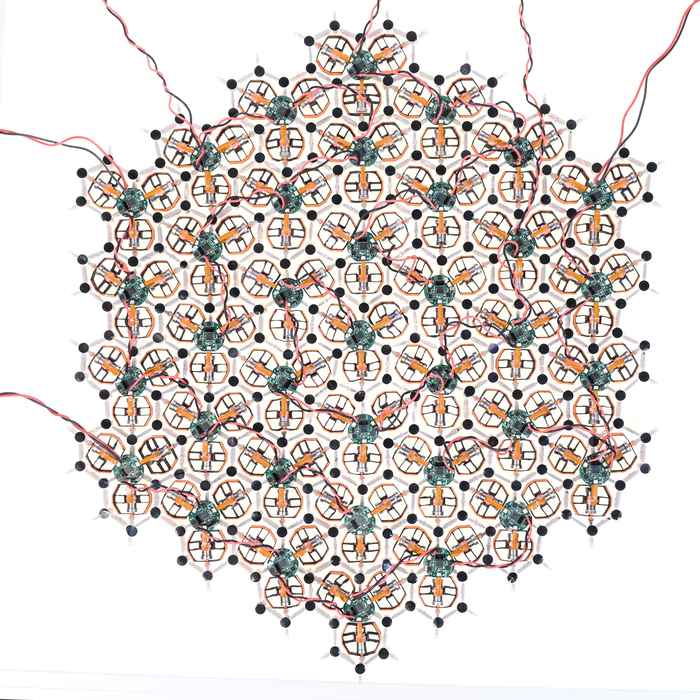
Now, an international team of physicists from the Universities of Amsterdam, Birmingham, Lyon, Delft, Leiden and Cambridge has combined the two ideas. Their question was whether the internal energy present in active matter could be sufficient to turn active materials into time crystals without needing an external rhythm. The answer turned out to be a clear “yes”: the team discovered a new way for active materials to develop a shared, stable oscillation without an external beat to set the pace. They demonstrated this in two elastic structures: a one-dimensional ring and a two-dimensional surface.
Playing with robots
Jonas Veenstra, one of the lead authors of the recent publication, was a PhD student at the University of Amsterdam when the research started and is now a postdoctoral fellow at ENS Lyon. The discovery was made while Veenstra was, in his own words, “playing with robots”: they would always organize in several specific patterns, but when coming back from a coffee break, only the largest pattern would be the one that the system had evolved to. Veenstra further explains: “Both of our lab-designed materials – or metamaterials – contain sensors and motors that let neighbouring parts influence one another. The trick was to make this interaction asymmetric: the response in one direction differs from the response in the other. When the materials were powered on, disordered local vibrations quickly led to small repeating wave-like deformations in the metamaterial. Then a process we call wave coarsening happens: the waves gradually grow in wavelength and amplitude while at the same time beating slower and slower, until eventually, a single global deformation spans the whole material.”
Jack Binysh, the other lead author of the paper, also started working on this project in the Amsterdam group, and is now an assistant professor in Robotics at the University of Birmingham. Binysh derived a phenomenological model that gave rise to the exact same behaviour as the one found in the lab. He explains why simply constructing a repeating pattern is not quite enough to call a material a time crystal: “Crucially, the experiments as well as the model show that random disturbances do not destroy the collective order as the size of the material is increased – the repeating pattern is very stable. This robust order is what makes the final state a time crystal. The name draws a parallel with ordinary crystals, such as ice, whose molecules form a repeating pattern in space. In our metamaterial, the order additionally extends through time, as building blocks stably maintain a coordinated, repeating motion.”
Large effort
Corentin Coulais is the group leader of the Amsterdam group where the research originated. Coulais, who like his two former collaborators is currently abroad, in Japan for a sabbatical leave, stresses the broadness and complexity of the research team that created the new materials.
Coulais: “Like the materials themselves, the research team that came up with them consisted of many moving and interacting parts. The work was a very collaborative effort, with two master students and one bachelor student from the UvA Institute of Physics joining, further collaborators at the universities in Delft, Leiden and Cambridge, and now also in Bermingham and Lyon. There was enormous help from the university’s Technology Centre in Amsterdam, and we had interns assembling the metamaterials with more than 100 sensor and actuators embedded, where each actuator needed more than 20 points of glue. There were 3d printed parts with different materials, and an in-house custom-made Lorentz actuator that converts electrical energy into mechanical motion.”
What’s next
The two time crystals that have been built are a one-dimensional chain and a two-dimensional surface, but the team is already developing three-dimensional active materials as well. These offer more ways for the building blocks to interact: shearing, bending and twisting can all occur and can influence one another, potentially producing a much richer range of movements. The goal is to understand how wave coarsening applies in three dimensions and use it to control a self-supporting material’s shape changes.
Veenstra: “With possible applications in mind, we have also started to think about multistability: making one material support several distinct, stable patterns of motion. Could we switch between these patterns and use each one for a different robotic function, such as a different shape change or direction of movement? Instead of designing a separate structure for every task, we could then use the different modes of a single material to achieve different behaviours, leading to very simple but highly multifunctional robots. Our ultimate aim is a biology-inspired form of robotics where coordinated behaviour emerges from carefully designed interactions between building blocks, rather than instructions from a central controller.”
Publication
Wave coarsening drives time-crystallization in mechatronic metamaterials, Nature 2026, J. Veenstra, J. Binysh, V. Seinen, R. Naber, R. Solé Borràs, D. Robledo Poisson, W. van Saarloos, A. Souslov and C. Coulais. (arXiv: 2508.20052)