UvA leads new European network on AI for fundamental physics
13 November 2026
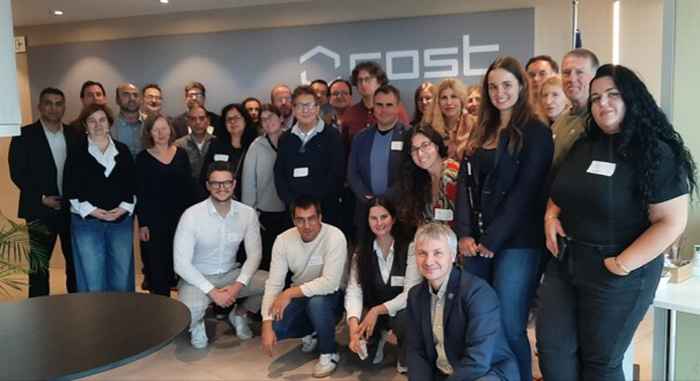
AIFORIA (Artificial Intelligence for Fundamental Physics: Open Roadmapping and Inclusive Actions) officially started on 1 November 2026 and runs until 2030. The network spans particle, astroparticle, nuclear and gravitational physics, and cosmology. AI is already part of everyday research in these fields. AI helps pick out rare collisions at the Large Hadron Collider, find gravitational-wave signals in noisy detector data and compare simulations of the universe with telescope observations. Upcoming facilities such as the Einstein Telescope, the LISA space mission and the Square Kilometre Array will produce far more data still. Yet each community largely develops its own methods and tools, and a central question remains open: when can AI results be trusted? Physics needs methods that state how certain they are and that respect known physical laws.
The European Coalition for AI in Fundamental Physics (EuCAIF) is a bottom-up community of researchers that Weniger co-founded and that has become a reference point for AI in fundamental physics in Europe. The COST network gives the coalition the means to meet, train and work together across borders. Weniger chairs the Action, with Verena Kain (CERN) as Vice-Chair. Together with the Working Group leaders, the leadership team brings expertise in collider physics and real-time AI at the LHC experiments, accelerator operations, lattice field theory, cosmology, gamma-ray astronomy and dark matter searches, and gravitational waves.
Three Working Groups
The three Working Groups are organised around methods, environment, and vision and training. The first of these groups asks which AI methods work best for discovery, using common test problems to compare them fairly. The second group looks at the environment these methods run in: shared software, data and computing, as well as agentic AI systems that can carry out parts of the research workflow on their own. The third group develops, together with EuCAIF, a joint European vision for AI in fundamental physics for the coming years, and trains the next generation of researchers through PhD schools.
The groups will meet for a joint kick-off in early 2027, and the first PhD school is planned for summer 2027. Young researchers and scientists from countries that are less represented in European research receive particular support.
“AI systems are starting to carry out parts of the research process themselves, and much of that development happens outside Europe,” says Weniger. “Nobody can predict where this will be in five years, but as a community we can agree, from the bottom up, on what we want to get right.”
How to join
AIFORIA supports networking, hackathons, PhD schools and short research exchanges. Researchers and innovators from academia and industry can join at any time. Anyone who is interested can create a free e-COST account and apply for one or more Working Groups via the Action's page on the COST website. More information will be available at aiforia.eucaif.org in the coming weeks.