Establishing blind spots in LC-HRMS analysis
25 June 2026
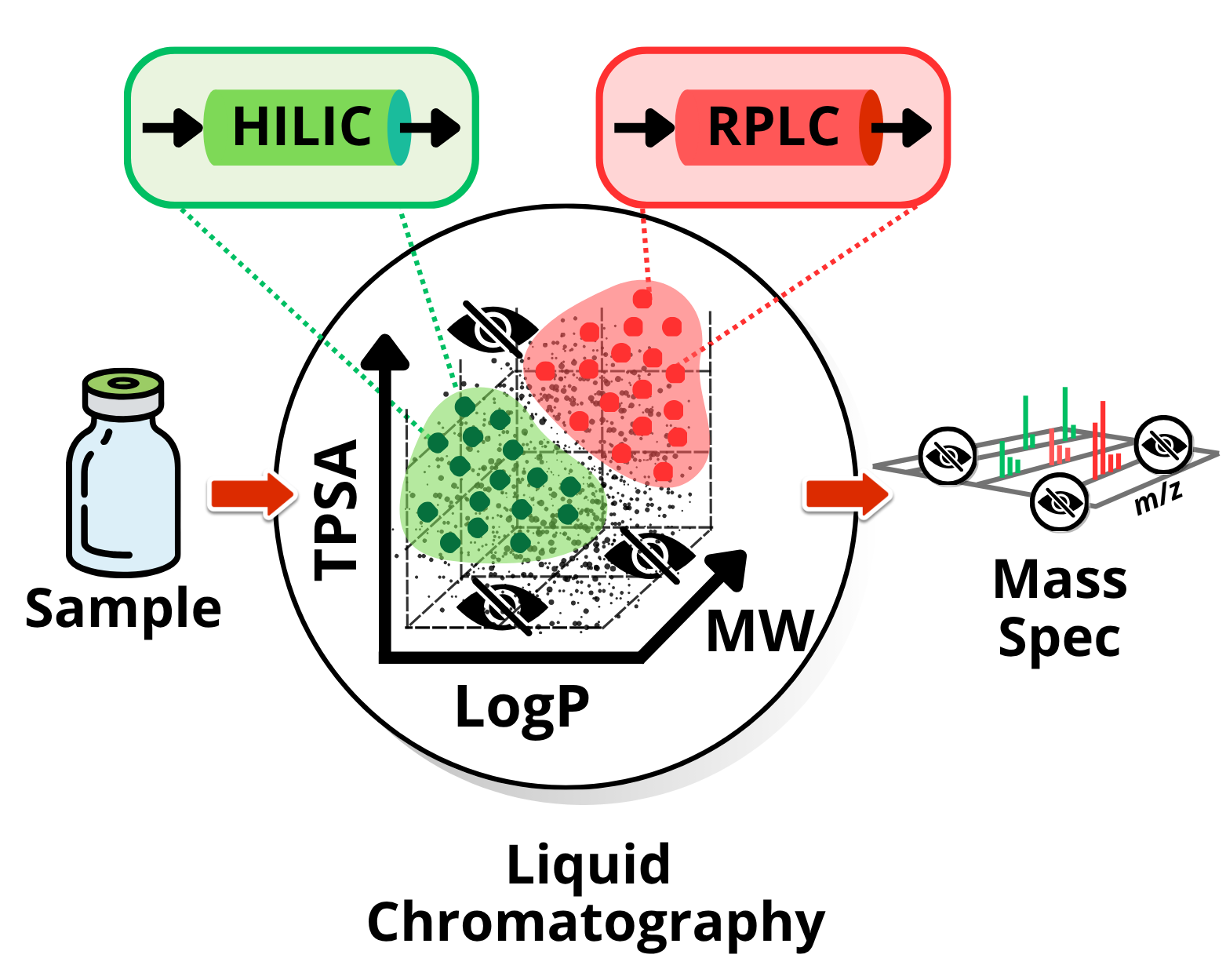
LC-HRMS is often viewed as a comprehensive tool for exploring chemical space. The question remains, however, how much of that space can actually be measured. To address this question, researchers at the Environmental Modelling & Computational Mass Spectrometry group led by Dr Saer Samanipour performed a meta-analysis of hundreds of LC-MS methods and thousands of compound measurements, investigating how chromatographic selectivity shapes the measurable chemical space.
Measurability trap
In their paper in Chemical Communications, co-authored by postdoc researcher Dr Lapo Renai and MSc student Jens Heemskerk, the researchers reveal a strong methodological convergence toward reversed-phase LC.
This creates what they describe as a "measurability trap": despite combining supposedly orthogonal approaches such as RPLC and HILIC, the chemical space covered by current methods remains highly overlapping. Rather than substantially expanding measurability, many workflows repeatedly sample similar physicochemical regions. This leaves large portions of environmentally and biologically relevant chemical space largely unexplored.
The findings highlight the need to consider chemical space coverage as a performance metric, alongside mass accuracy, sensitivity, and feature detection, when designing non-targeted LC-HRMS workflows.
Abstract, as published with the paper
Liquid chromatography high-resolution mass spectrometry enables broad chemical detection by comprehensive accurate mass to charge ratio measurement of the components in complex samples; yet, analytical design constrains chemical space measurability. A meta-analysis of 236 methods and over 75,000 measured compounds reveals strong convergence toward reversed-phase separations, limiting the coverage of sample chemical diversity. This ‘‘measurability trap’’ narrows the observable chemical space and can lead to the underrepresentation of many environmentally and biologically relevant compounds.
Paper details
Lapo Renai, Jens Heemskerk, Frederic Béen and Saer Samanipour: Chemical space blind spots: how chromatographic selectivity dictates chemical measurability and coverage of LC-HRMS comprehensive analysis. Chem. Commun., 2026, Advance Article DOI: 10.1039/d6cc02811j
See also
Research group Environmental Modelling & Computational Mass Spectrometry