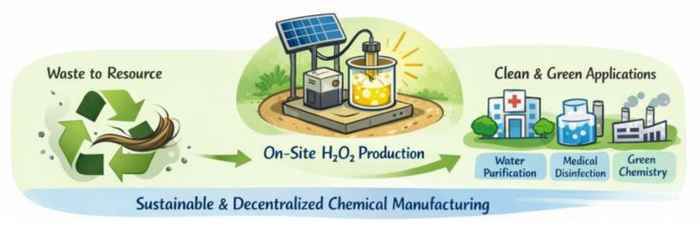
Turning yesterday's haircut into tomorrow's clean technology
NWO Open Mind funding for unorthodox catalyst concept
25 June 2026
If successful, the proposed project could render the production of hydrogen peroxide, an essential compound in water treatment and healthcare, fully sustainable. Its current industrial production is energy-intensive and generates around three kilograms of CO2 for each kilogram of hydrogen peroxide produced.
The bold proposal of the Amsterdam researchers is to engineer waste human hair into a high-performance photocatalyst that can enable efficient solar-driven H2O2 synthesis under mild conditions. Adding to this, they propose to use organically contaminated industrial wastewater containing pharmaceuticals, dyes, and phenols as feedstocks. By thus coupling solar-driven chemistry with waste valorisation, this could establish a circular, low-cost production route for hydrogen peroxide.
Rich in carbon, nitrogen, and sulphur
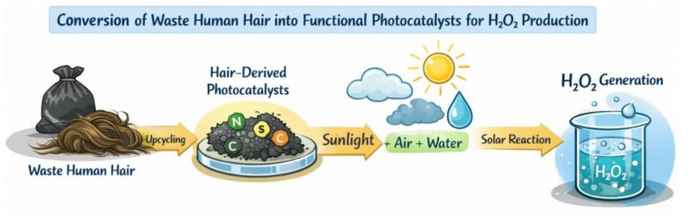
Human hair is rich in carbon, nitrogen, and sulphur, which are the very elements needed to build efficient photocatalysts. The challenge now is to re-engineer this abundantly available waste product into a porous material that combines catalytic activity with light-harvesting and charge transport properties. This is a high-risk endeavour due to biological heterogeneity, reproducibility challenges, and uncertain catalytic efficiency under polluted water. There are significant hurdles to be taken, amongst others in controlling the uniformity and stability of the catalyst, and its scalable synthesis.
Decentralised circular urban frameworks
According to Verma and Raveendran, their green catalysis concept can lead to scalable solutions for water treatment, healthcare, and environmental sustainability worldwide. They envision decentralised circular urban frameworks, connecting research laboratories with local salons, municipalities, and water treatment facilities. If successful, this will lead to the production of cheap, sustainable and decentralised hydrogen peroxide as an oxidant for hospital hygiene and precursor for industrial chemical synthesis. Adding to this, the successful implementation of the proposed concept will pave the way to better waste-hair and waste-water management.