Wim Noorduin and Arian van Asten nominated for Huibregtsen Prize 2026
24 August 2026
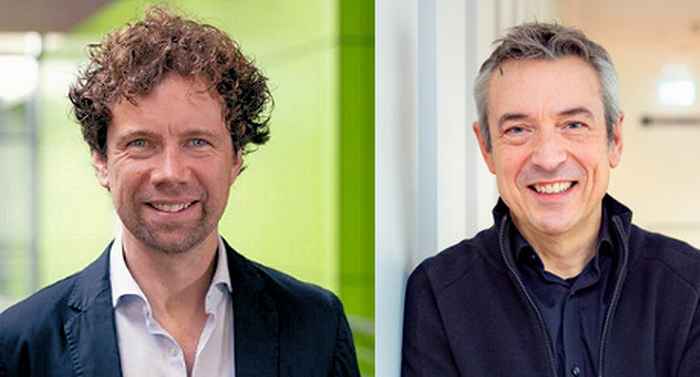
Noorduin and Van Asten are nominated for the development of a method for detecting lead, and its application in forensic investigations. According to the jury, “The original research project by chemists Noorduin and Van Asten has an exceptionally strong narrative and scores highly across the board. It is a compelling example of how curiosity-driven research can have an enormous impact on society, even when that impact could not have been precisely predicted in advance.”
Responding to the news about the nomination, Noorduin says: “It’s great to see that our research, that started out as very fundamental, is now making a real impact on society.”
From perovskites to detecting gunshot residue
Noorduin, professor of Self-Organising Matter at UvA and group leader at AMOLF, developed the method for lead detection as a spin-off from his research into the controlled self-organisation of mineralised structures. One of the materials under study are perovskites, a very promising class of materials for application in solar cells. While working from home during the COVID pandemic, Noorduin realised that their light-emitting properties could help visualise lead atoms. This led to the development of a chemical method for detecting the presence of lead in the environment.
Today, the startup company Lumetallix distributes the lead detection kit worldwide, helping to address the global problem of lead poisoning. A next important step was the collaboration with Arian van Asten, professor of Forensic Analytical Chemistry and On-Scene Chemical Analysis at UvA. Together, they developed the lead detection test into a method for detecting gunshot residue. This method is faster, more sensitive, and easier to use than current alternatives. Forensic experts at the Amsterdam police are already testing it in real-life crime scene investigations.
About the Huibregtsen Prize
The Huibregtsen Prize was established in 2005 by the board of the foundation ‘Avond van Wetenschap en Maatschappij’ (Evening of Science & Society). It is named after its founder Mickey Huibregtsen. The prize is awarded to a recent research project that combines scientific quality and innovation with exceptional social added value or outreach. The 2026 prize will be presented at the ‘Evening of Science & Society’ to be held on 8 October in the Pieterskerk Leiden. It consists of ‘De Denker’ (The Thinker), a sculpture by visual artist Wil van der Laan, a cash prize of €25,000 earmarked for research activities, and a workshop offered by the Lorentz Centre in Leiden.