Chemical signalling mimics key neuronal properties
3 September 2026
Supramolecular chemistry deals with developing synthetic systems that capture the properties of life. An important aspect of life is that is able to make decisions based on information, which is controlled by neurons. These use so-called time-dependent gating to process incoming signals with high precision. On a cellular level, they open and close specific ion channels progressively over a specific duration, in response to an electrochemical stimulus.
Temporal dependence in a chemical reaction network
In their paper in Chemical Science, the researchers at the research group Homogeneous, Supramolecular and Bio-Inspired Catalysis led by Prof. Reek describe a synthetic system that mimics this time dependency. For this, they coupled two input-gated chemical reactions: a thermodynamically uphill, fuel-driven acid-to-anhydride cyclization reaction; and a light-driven decarboxylation reaction.
The anhydride is metastable and hydrolyses back to the acid, unless it is converted further in the light-driven decarboxylation reaction that selectively converts the anhydride. This introduces time dependence between the two reactions and their inputs: The final product will only form when both inputs are correctly timing-aligned.
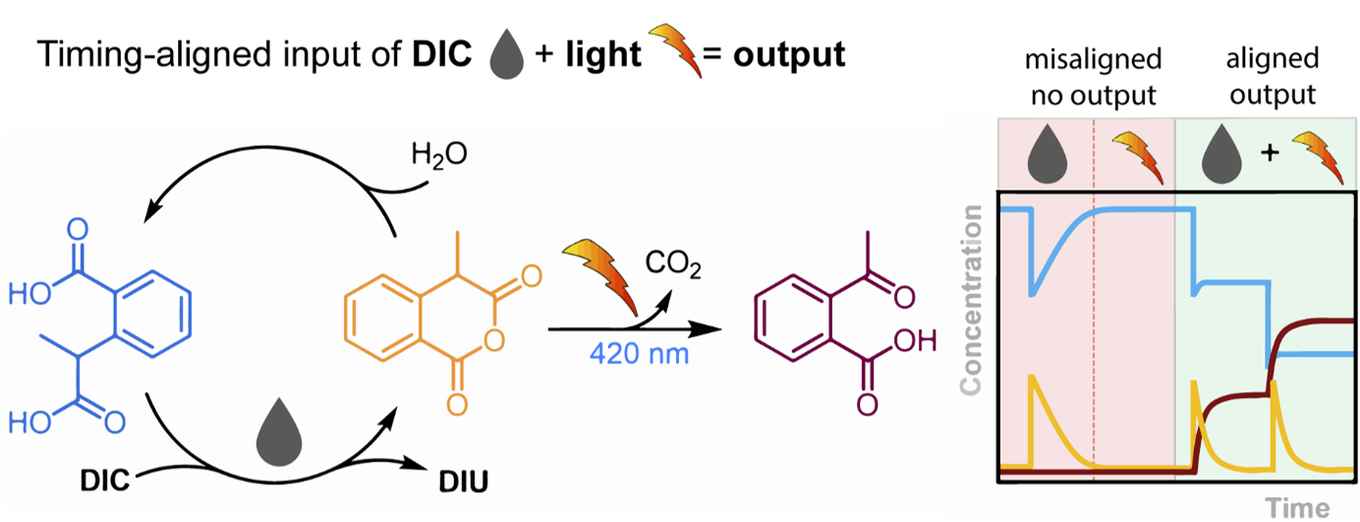
This time-dependent property can be further explored to develop an elaborate system for chemical information processing with high precision. This could not only provide a platform to study the role of temporal gating in biological regulation. It can also offer new strategies for adaptive catalysis and chemical computing.
Abstract, as published with the paper
Neurons process multiple stimuli in a temporally dependent manner, which filters noise and enables precise control over complex functions. Synthetically mimicking neuronal processes may be useful for autonomous chemical systems that are able to make their own decisions, yet such time-dependence has not found an equivalent in synthetic reaction networks. Herein, we show that carbodiimide driven equilibria between acid and anhydride can be coupled to photochemical decarboxylation from which temporal input dependence emerges. Under optimized conditions, the decarboxylation of the anhydride is much faster than the acid. However, the anhydride hydrolyses back to the acid, and as such is only temporally present after carbodiimide addition, which limits its conversion to this time period. The network therefore displays temporal dependence, as the product is only generated when both carbodiimide and light inputs align in time. Such systems provide a platform to explore the role of temporal gating in biological regulation and offer new strategies for adaptive catalysis and chemical computing.
Paper details
Rens Ham, Bettina Baumgartner and Joost N.H. Reek Temporal dependence emerges from a carbodiimide driven acid–anhydride equilibrium coupled to a photocatalytic decarboxylation reaction Chem. Sci. 2026, DOI: https://doi.org/10.1039/d6sc03290g