Dick Stufkens Prijs 2026 awarded to Lars van der Zee
17 October 2026
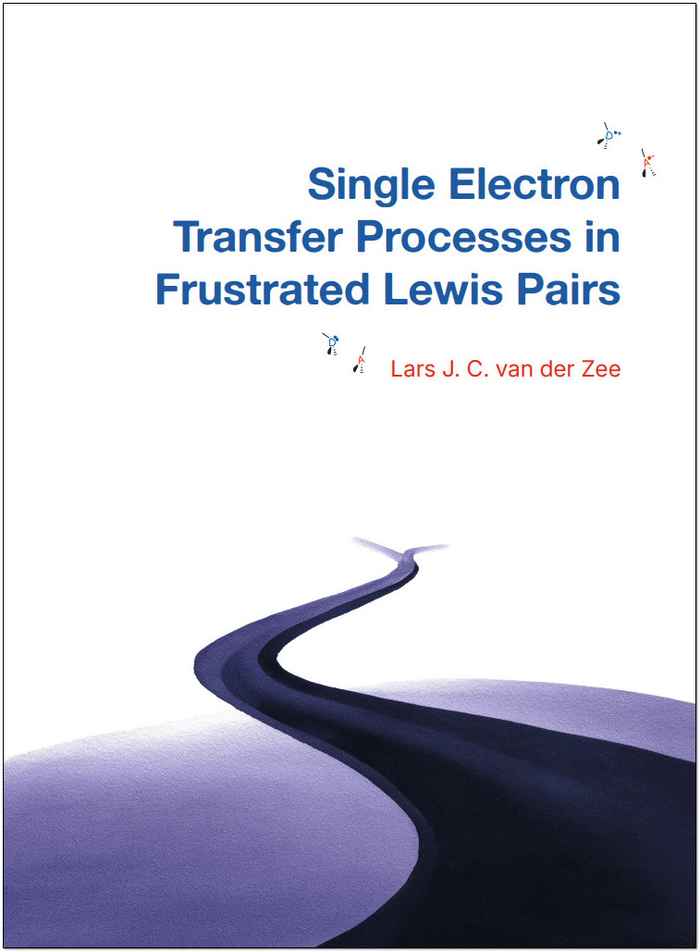
In his thesis, supervised by Prof. Chris Slootweg and Dr Andreas Ehlers at the UvA’s Van ‘t Hoff Institute for Molecular Sciences, Van der Zee provides an in-depth description of of single-electron transfer (SET) processes in so-called Frustrated Lewis Pairs. His outstanding research has led to a better understanding of the mechanisms underlying their reactivity and application.
Radical FLP chemistry
Frustrated Lewis Pairs (FLPs) are sterically hindered pairings of a Lewis acid (an electron acceptor) and a Lewis base (an electron donor). Due to the presence of bulky substituents, these pairs are unable to form a stable adduct. This leaves a reactive site where small molecules can be activated. As an example, a hydrogen molecule can be coaxed to form a proton and a hydride ion. In general, FLP chemistry enables metal-free catalysis, avoiding the use of expensive or toxic metals.
FLP chemistry typically revolves around the transfer of electron pairs, but more recently it was found that certain FLP’s also induce single-electron transfer (SET). This generates radical ion pairs which in turn can potentially activate inert molecules such as methane.
A broad range of disciplines
When Van der Zee started his PhD research in 2021, the understanding of the formation of radicals in FLP’s was still quite limited. His thesis provides a very significant deepening of the insight in SET processes. To this end, he efficiently combined a broad range of disciplines—from synthesis of a variety of FLPs to advanced spectroscopy, electrochemistry, molecular photonics, computational chemistry and theoretical chemistry.
According to the jury of the Dick Stufkens Prize 2026, Van der Zee “has thoroughly familiarised himself with all these disciplines and utilised them to the fullest. Reading the thesis, it is clear that he followed an interdisciplinary approach resulting in an overall very high level of quality work.”
The jury particularly praises Van der Zee’s efforts to make a clear distinction between thermal SET and photochemical SET. By studying quinones as electron acceptors in combination with triarylphosphines and triarylamines as electron donors, a thorough understanding in the thermal SET process was gained, whilst the use of pnictogen-based donors and boranes as acceptors generated insights into the photochemically induced SET process. A testimony to Van der Zee’s dedication is that he developed a new efficient synthesis route for the borane compounds needed for his study of photochemical SET, avoiding the use of a Sn catalyst.
Highly impressed
The jury also notes that Van der Zee achieved the high level of his thesis through his collaboration with multiple research groups of the Holland Research School for Molecular Chemistry, especially in the fields of advanced EPR spectroscopy, transient absorption spectroscopy, molecular photonics, computational chemistry and solid state characterisation. Additionally, collaborations with researchers of TU Delft and outside the Netherlands led to further deepening of the theoretical and practical understanding of this research.
All in all, the jury is highly impressed by the quality of the in-depth studies conducted by van der Zee, which have resulted in seven publications, including three in the high-impact journal Angewandte Chemie. A 2023 paper in Chemical Reviews, mirroring chapter 2 of his thesis, has been cited more than 80 times, showing the relevance of his PhD work for the wider scientific community.
About the Dick Stufkens Prize
The Dick Stufkens Prize is awarded annually to the best thesis defended in the period July 1 to July 1 of the next year by a PhD student belonging to the Holland Research School of Molecular Chemistry (HRSMC). The prize – first awarded in 2008 - consists of a certificate and an amount of 2000 euro. The prize will be presented to Lars van der Zee at the annual HRSMC symposium; the 2026 edition will be held on 20 November 2026 in the O|2 Lab building at Vrije Universiteit Amsterdam where Van der Zee will give a talk on his award-winning research.
About the HRSMC
The Holland Research School of Molecular Chemistry was founded in 1994 and has been re-accredited three times by the Royal Netherlands Academy of Arts and Sciences (KNAW). The Research School combines research groups working on synthesis, spectroscopic characterisation and theoretical and computational description of molecular systems from the University of Amsterdam, VU Amsterdam, Leiden University and Radboud University Nijmegen. Apart from creating the appropriate conditions for further collaboration between the participating groups, the school also provides an internationally highly acclaimed teaching program for talented PhD and MSc students in molecular chemistry and physics. The late Prof. Dick Stufkens, scientific director during the period 1997-2001, was one of the driving forces behind the HRSMC. Among other things, his efforts have contributed greatly to the international reputation of the HRSMC.