ERC Starting Grant for Bettina Baumgartner
Using nanoconfinement to advance sustainable catalysis
12 November 2026

“Many researchers are exploring the use of MOFs and other porous materials for a wide range of chemical transformations”, says Baumgartner. “When they see chemical reactions behaving differently inside these materials, as compared to a homogenous environment, the differences are often attributed to so-called ‘confinement effects’. This term is frequently used as a catch-all explanation, without specifying the underlying mechanisms responsible for the observed changes in reactivity. With REFRAME, I want to measure, understand, and predict these effects”, says Baumgartner. “Ultimately, the goal is to use this knowledge to make catalytic reactions work in greener solvents, such as water”.
Achieving truly sustainable catalysis often is quite a challenge since many chemical reactions rely on toxic, apolar solvents. Replacing those with greener alternatives like water is difficult since such polar solvents fundamentally alter how molecules interact and react. With REFRAME, Baumgartner now wants to use the concept of nanoconfinement to make green solvents behave like apolar ones. “When liquids are confined inside nanopores, their polarity and mobility collapse”, she explains. “This creates microscopic reaction pockets of low polarity that mimic enzyme selectivity, while being robust to non-biological conditions.”
Building a measurable, predictive model
Baumgartner will use the ERC Starting Grant to get to the bottom of the nanoconfinement concept, to understand and effectively exploit its features.
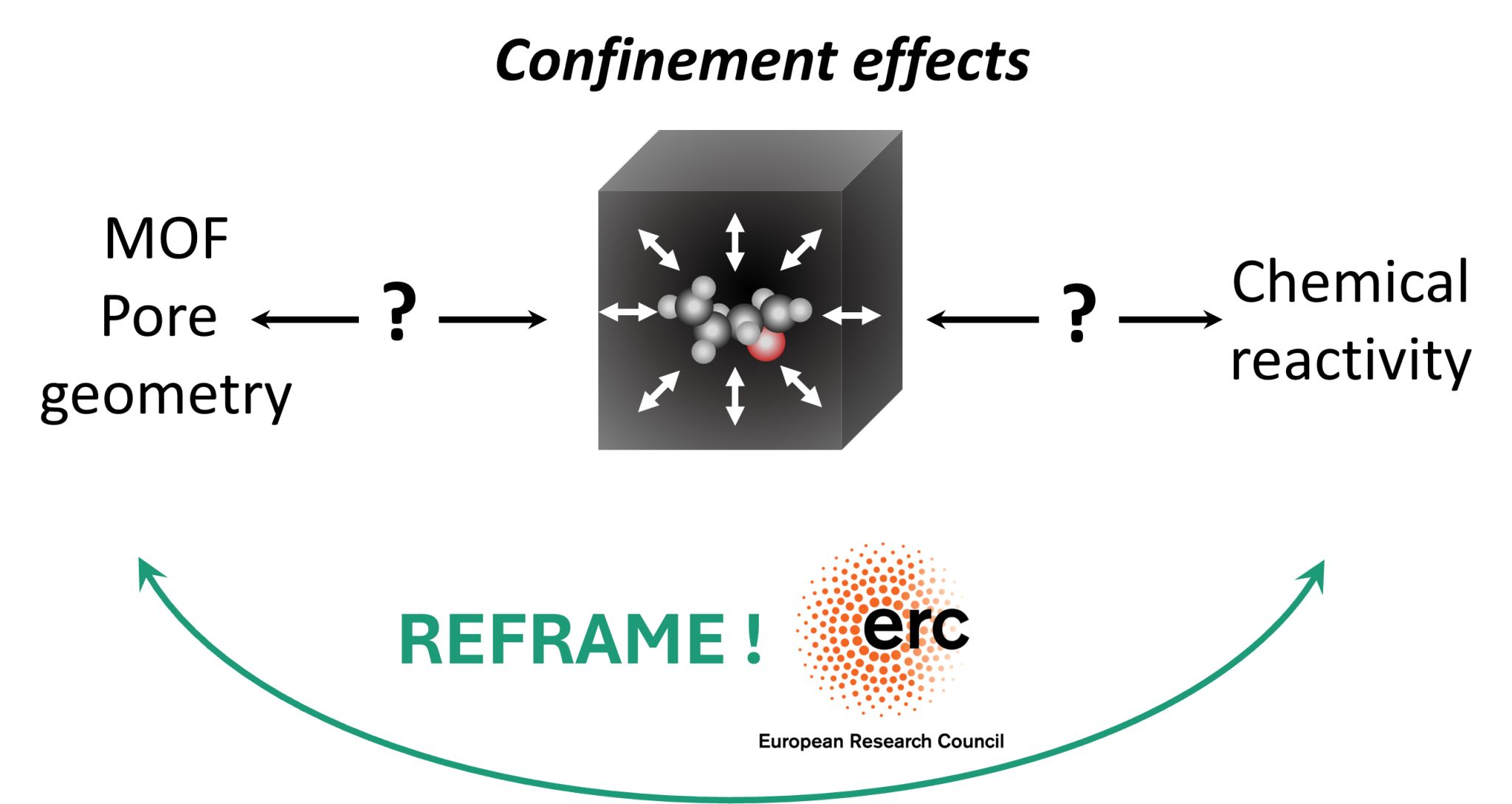
“We want to elucidate the relevant phenomena - solvent restructuring, competitive adsorption and diffusion, or molecular alignment – that actually drive the effects of nanoconfinement. We will move beyond the usual qualitative explanations and really quantify how confinement controls catalysis at the molecular level.” By combining in situ spectroscopy with systematically designed confined spaces based on MOFs, Baumgartner hopes to build a measurable, predictive model linking microscopic structure to macroscopic reactivity.