UvA intake: more Bachelor’s students, fewer Master’s students
10 November 2026
These are the preliminary figures from mid-October 2026; the final figures will, as always, become available in February of the new calendar year.
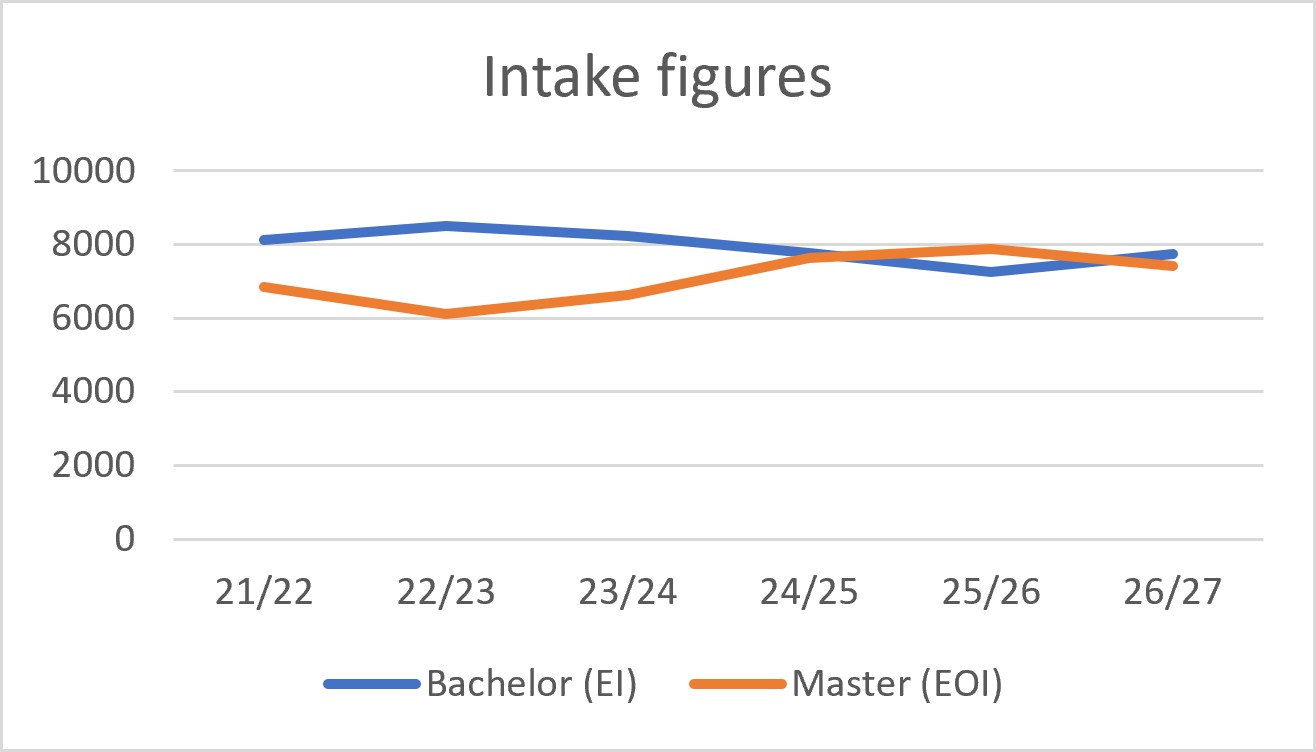
‘Bachelor’s enrollment is growing, but this growth is concentrated in a select number of degree programmes,’ says Vinod Subramaniam, president of the UvA Executive Board. ‘In some faculties, a clear decline is visible. Among Master’s programmes, we see a broader decrease, which may be partly linked to lower Bachelor’s enrollment in previous years. We therefore need to look beyond the figures for a single year. In the longer term, we anticipate a contraction due to demographic trends. At the same time, we must now work to bring the number of international Bachelor’s students into better balance, as we have agreed with the other universities.’
Self-regulation
The UvA, in coordination with other Dutch universities, has reached agreements – known as ‘self-regulation’ – aimed at reducing the intake of international students in Bachelor’s programmes and achieving a better balance between Dutch and international students. Despite various measures, the targeted reduction has not yet been fully met for the current academic year; consequently, for the 2027–2028 academic year, the UvA has tightened existing numeri fixi (fixed admission quotas) or introduced new ones for several English-language Bachelor’s tracks.
Subramaniam says: ‘We are making adjustments carefully and incrementally, with due regard to the quality, accessibility, and feasibility of our education. In doing so, we aim to distribute the impact fairly across faculties and over time. Taking overly drastic steps all at once could place unnecessary pressure on degree programmes, students, and staff. The UvA remains an international university. We consider this essential: diverse experiences and perspectives enrich our teaching and research, and cross-border collaboration helps us address societal challenges.’
The key figures at a glance
Bachelor’s intake
The total Bachelor’s intake across the UvA increased from 7,259 to 7,734 students (+6.5%). There is an increase in both Dutch and international first-year Bachelor’s students. The growth is smallest among students from non-EEA countries: +2.3%.
Master’s intake
Overall, the intake for Master’s programmes decreased: from 7,872 to 7,432 (-5.6%). The number of new Master’s students from non-EEA countries shows the sharpest decline (-7.9%), followed by the number of new Master’s students from the Netherlands (-7.4%). The intake from EEA countries for Master’s programmes remains virtually unchanged (-0.5%).
Picture at the faculties
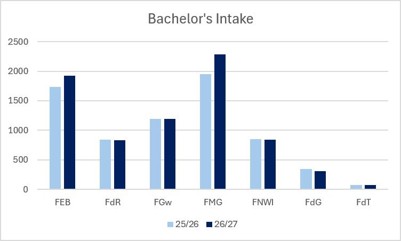
The picture regarding Bachelor’s degree intake varies significantly from faculty to faculty. At the Faculty of Social and Behavioural Sciences (FMG) and the Faculty of Economics and Business (FEB), the intake increased by 17% and 10.6%, respectively. For the FMG, this is primarily driven by growth in Political Science and Global Communication Science (the English-language track of Communication Science). The rising popularity of Political Science may be linked to current geopolitical developments. In the case of Communication Science, the intake dropped sharply during the 2024–2025 academic year, when a numerus fixus was in place for the entire programme – a measure that applied only for that year. Following growth last year and this year, intake is gradually returning to its previous level. At the FEB, there was a notable increase in the number of Dutch-speaking first-year students in the Business Administration programme. As of the 2025–2026 academic year, this programme includes a Dutch-language track.
Intake for Bachelor’s programmes at the Faculty of Law (FdR), the Faculty of Science (FNWI), and the Faculty of Humanities remains largely unchanged compared to last year, with shifts of -0.8%, -0.8%, and -0.3%, respectively.
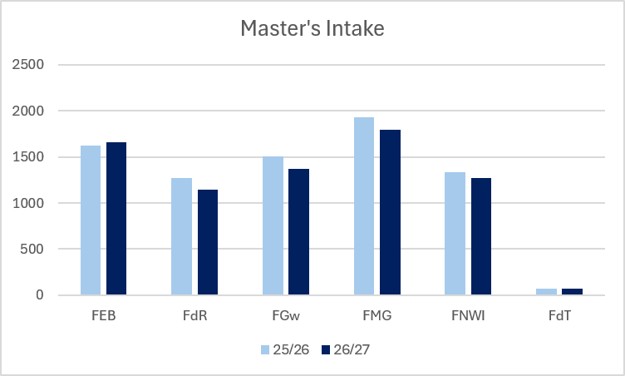
The intake of new Master’s students declined significantly across almost all faculties: FdR -9.5%, FGw -8.7%, FMG -7.2%, and FNWI -4.3%. Only the FEB has seen an increase in Master’s student intake, at +2.2%. That faculty experienced a sustained rise in Bachelor’s student intake in previous years, which is now translating into an increase in Master’s student intake.
Total number of students
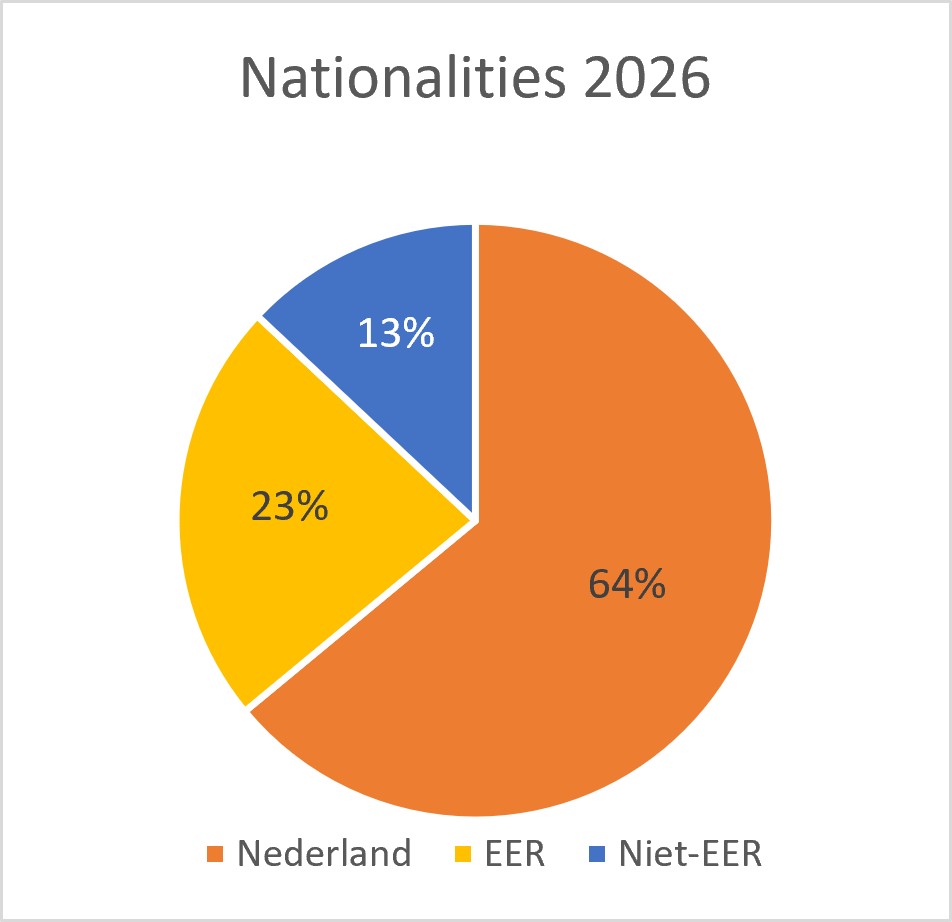
Since 2015, the total number of students enrolled at the UvA had been increasing every year. Last year, for the first time, this trend changed. This year, the total number is once again decreasing, falling from 43,147 to 42,601 students (-1.3%). Of this total, 27,178 are from the Netherlands, while 15,423 are international students.