From a baby's smile to a monkey's grin: how emotions shape our behaviour
24 September 2026
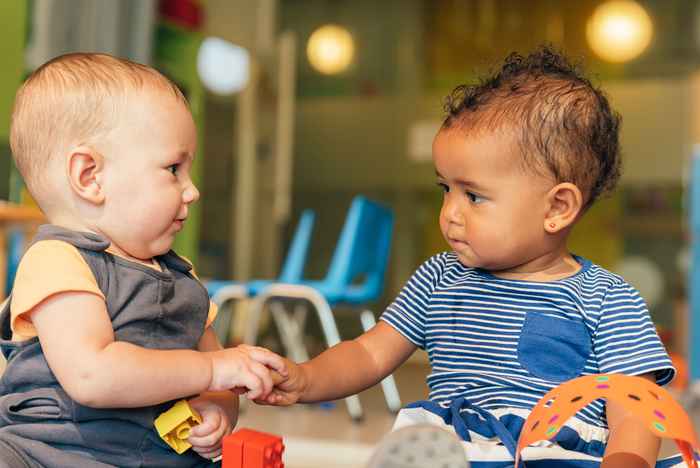
The issue shifts the focus from recognising feelings in others to what occurs within the person expressing the emotion. The guest editorial team adopts a broad perspective: emotional expressions are examined in terms of their origins and development, the commonalities across different animal species, and the roles they play in our behaviour and our lives with others. In this way, emotions are viewed as a visible inner world that acts as a link between brain, body and environment.
Babies initiating shared moments
The special issue comprises a total of 19 articles. Researchers from the UvA provide several key contributions. One study, co-conducted by Cristina Colonnesi, examines how babies in their first year of life shape positive moments with others through smiling. The researchers observed that 8-month-old babies – more so than 4-month-olds – initiate moments of shared positive emotion themselves, for example by smiling and then engaging in mutual laughter with an adult. Rather than primarily reacting to another person's smile, older babies increasingly use their own positive expressions to initiate and sustain warm, enjoyable interactions. This emerging ability may indicate growing flexibility in how babies use their emotions in social contexts.
The body language of shame and guilt
Milica Nikolić demonstrates that self-conscious emotions – such as shame, guilt, shyness or pride - re already visible in a child's facial expressions, body posture and gaze during their first few years of life. These emotions arise when children view themselves through the eyes of others and prove to be more than just an internal feeling.
Various studies show, for instance, that when children feel guilty about something that went wrong, they are subsequently more likely to try to make amends—by helping, sharing, or repairing damage. In contrast, with shame, children are more likely to withdraw, avoid eye contact, or try to steer clear of certain situations. Nikolić and her colleagues emphasise that while the evidence is still limited, these emotions likely play an early role in shaping social behaviour and reputation.
Not every positive emotion comes with a smile
Disa Sauter and her team demonstrate that positive facial emotions are far more than just ‘a smile’. In a study of 22 different positive emotions, based on participants' personal experiences, they examine which facial muscles and movements are activated for each one. They found that certain positive feelings have their own distinct facial profiles that do not involve smiling – such as interest or determination. In the case of determination, the key characteristic is a raised chin.
Other positive emotions, such as amusement or elation, do involve distinct smiles – with upturned corners of the mouth, and often closed eyes and strongly raised cheeks. Through this work, the researchers show that ‘feeling good’ manifests in various facial expressions – even spontaneous ones – and that not every positive emotion comes with a classic smile.
‘Play face’ as social mirror
A fourth study, authored by postdoc Christopher Riddell, Milica Nikolić and colleagues, compares the mimicry of "play faces" – exaggerated, playful expressions resembling smiles, often seen during rough-and-tumble play – across infants, adults and orangutans. Infants and adults are more likely to make a play face themselves when observing one in another person than when the other person has a neutral expression; their own expression mirrors what they see, even in the absence of direct interaction with the person being mirrored. Orangutans rarely exhibit this behaviour. This suggests that, for them, play faces arise primarily during direct social play, whereas in humans, "contagious smiling" can occur outside such play contexts.
Studying emotions where they actually occur
Collectively, the contributions to this special issue demonstrate that emotional expressions play a central role early in development – both in how we behave and in the formation and regulation of social relationships – ranging from a baby’s first smile to the complex body language associated with self-conscious emotions. In their editorial, Nikolić, Kret, Nummenmaa and Sauter call on researchers to study emotions more within real-life contexts, paying attention to how expressions emerge, develop and function for both the individual and those around them.